
Review · HIROSHIMA
Hiroshima 3hr Peace Cycling Tour with Local Guide
Hiroshima’s story comes into sharper focus when you move through the city instead of seeing only one memorial. This three-hour e-bike tour links the Peace Park with Hiroshima Castle, rivers, bridges, railway tracks, survivor trees, and small monuments that are easy to miss on foot.
I like two things right away: the small group of up to 10 keeps the guide close, and the mostly flat route lets you cover far more ground than a walking tour. Guides such as Shin and Moe have also shared family connections to the bombing, giving the history a personal voice.
The main consideration is emotional weight. This is not a light sightseeing ride, even though the cycling is gentle. You will hear about mass suffering, damaged buildings, and the long effects of August 6, 1945, so give yourself quiet time afterward.
Key points to know before booking
- Personal stories from local guides: Shin, Moe, Kana, Toma, and Thomas have led tours, with some guides sharing family experiences connected to Hiroshima.
- A wider route than the standard Peace Park visit: You reach Hiroshima Castle, Gokoku Shrine, Higashisenda Park, the Red Cross Hospital site, surviving railway cars, and Miyuki Bridge.
- Easy e-bikes on a generally flat route: The bicycles help in warm weather and make the distance manageable for less confident cyclists.
- Small groups capped at 10 people: The format allows more direct questions and a closer pace with the guide.
- Three hours with a choice of start times: The morning tour runs from 10:00 to 13:00, while the afternoon tour runs from 14:00 to 17:00.
- Rain backup available: You can switch to a walking route focused on the Peace Park, Atomic Bomb Dome, hypocenter, former Bank of Japan, and Fukuromachi Elementary School, or request a refund if the tour cannot run.
Why a bicycle helps you understand Hiroshima
The usual Hiroshima visit concentrates on the Peace Memorial Museum, the Atomic Bomb Dome, and the surrounding park. Those places matter, but the city’s story spreads well beyond them. This ride follows the bomb’s path through different distances from the hypocenter, allowing you to see how destruction gave way to recovery.
You begin at the Hiroshima Peace Park Rest House. After introductions, a route briefing, and a temperature check, you get acquainted with the bike and the group. The meeting point is near public transportation, but there is no luggage storage at the Rest House. If you have bags, coin lockers are available about six minutes away at the International Conference Center Hiroshima and the Peace Memorial Museum.
The bicycles are electric, and the route is described as gentle and relatively flat. That matters in Hiroshima, especially during hot weather. You still need to be comfortable riding a bicycle, stopping often, and moving with a small group through city streets. The guide may slow the pace if someone, particularly a child, is not used to cycling.
The group size is one of the strongest features. Ten is the maximum, and some departures may be smaller. A compact group makes it easier to hear personal stories, ask about a monument, and stay together without turning every stop into a crowd-management exercise.
A few more rides around Japan worth a look
- Hiroshima in a Nutshell: Morning Bike Adventure
★ 5.0 · 524 reviews - Hiroshima 2hr Peace Cycling Tour with Local Guide
★ 5.0 · 321 reviews - Hiroshima: Peace Cycling Tour with Local Guide
★ 4.8 · 286 reviews
Hiroshima Castle and the military city before 1945
The first major stop is Hiroshima Castle, reached just after leaving the Peace Park. The castle site helps shift your view of Hiroshima from memorial city to a place with a much older role as a military and political center.
The guide explains that the military fort here was the first location to report the atomic bomb. That detail gives the castle a direct link to the morning of August 6, rather than treating it as a separate sightseeing stop.
You spend about 20 minutes here, with admission included. The time is short, so this is not a full castle visit. Think of it as historical context and a place to understand Hiroshima before the bombing. If you want a long look inside the castle, you would need to return on your own.
Gokoku Shrine and the details that survived
From the castle, the route continues to Hiroshima Gokoku Shrine and its gate. Here you hear about lesser-known remnants, including a Guardian Dog statue and the shrine gate that withstood the blast.
This is where the bicycle format begins to pay off. You are not simply moving between famous names on a map. You are stopping at smaller pieces of evidence, often in places that can pass unnoticed during a self-guided visit.
The stop lasts around 15 minutes. The shrine is still an active religious site, so the visit requires the usual respect and a willingness to listen rather than treat every object as a photo prop.
Central Park, Aioi Bridge, and the Atomic Bomb Dome
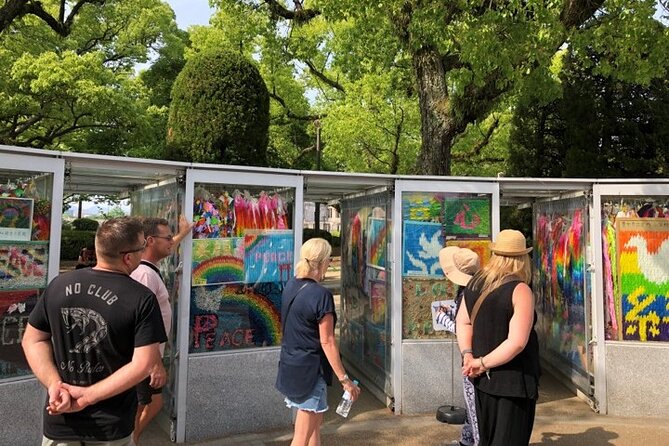
Hiroshima Central Park provides a brief change of pace. You walk through a broad green area for about 20 minutes, seeing the city’s present-day calm before returning to the more solemn memorial sites.
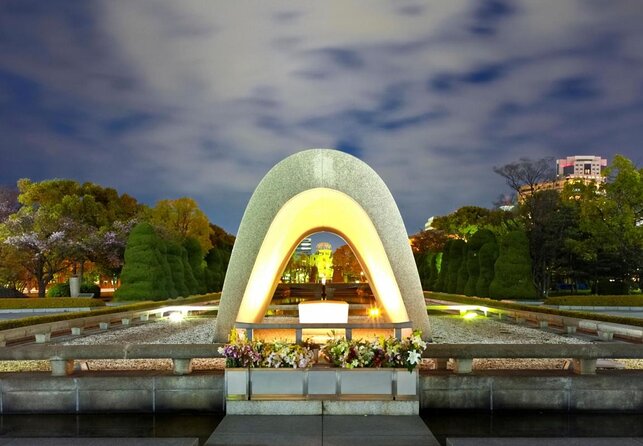
Next comes Aioi Bridge, the intended target of the atomic bomb. The bridge and river remain part of the modern city, making the site powerful in a restrained way. You can look at the geography and understand why the bridge was used as a reference point, while the guide explains what happened around it.
The Atomic Bomb Dome follows. You spend about 15 minutes here, learning about the building, local memories, and the damage that left its frame standing. This is one of Hiroshima’s most familiar sights, but hearing its story while approaching by bicycle gives the visit a different rhythm. You are coming from several related sites, not arriving with no context.
The Dome can be busy, particularly during school visits and popular sightseeing hours. The tour does not remove that public setting, but the guide helps focus your attention on what you are seeing.
Same roads, a different day in the saddle:
- Tokyo Great Cycling Tour
★ 5.0 · 811 reviews - Tokyo Top Highlights 3h Guided E-bike Tour
★ 5.0 · 714 reviews - One-Day Osaka Bike Adventure: 5–6 Hours
★ 5.0 · 246 reviews - Eat, Drink & Cycle: Osaka Foodie Bike Tour
★ 5.0 · 224 reviews
The riverside route and Peace Bridge
After the Atomic Bomb Dome, you head south along the Motoyasu River and cross the Peace Bridge area. The riverside section brings a little open air into an otherwise serious morning.
The guide connects the river, the bridge, and the surrounding city to the history of the bombing and the rebuilding that followed. Cycling also lets you see Hiroshima as a living place. The city is not frozen in 1945, and the route makes that clear as memorial spaces give way to streets, parks, and daily activity.
This portion is not about collecting another major attraction. Its value is in linking the central memorial area with the wider city. You see how close the historic sites are to ordinary neighborhoods and how Hiroshima’s present sits beside its painful past.
Higashisenda Park and the Red Cross Hospital window
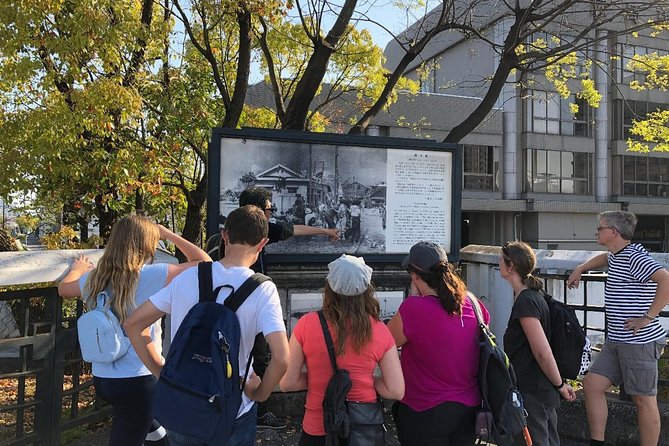
At Higashisenda Park, roughly one kilometer from the blast center, the focus turns to trees and international remembrance. Trees from countries around the world grow here, and the guide explains the stories connected with the site.
The park stop lasts about 20 minutes. It is a useful pause because the setting is open and green, yet the subject remains tied to the bombing and the city’s recovery. You are given time to look around instead of racing from one marker to the next.
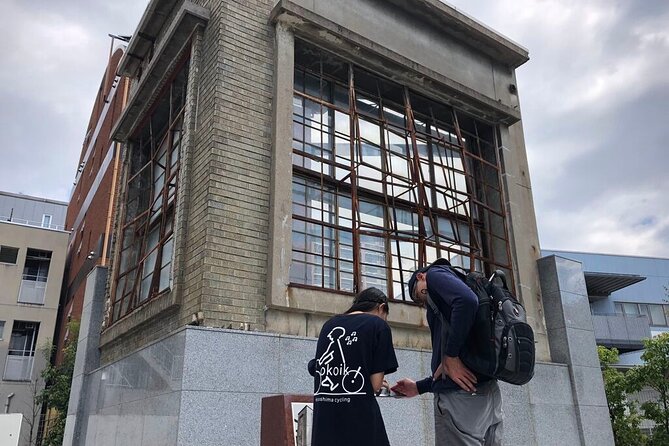
The Atomic Bomb Window Frame Monument at the former Hiroshima Red Cross Hospital is one of the tour’s harder stops. The remaining window frame and building fragments show the force of the blast in a direct, physical way. You are now about 1.5 kilometers from the hypocenter, yet the damage was still severe.
This stop can be difficult. The tour does not soften the reality with a quick photo opportunity. The guide explains what the site reveals, and you have time to take it in.
Surviving railway cars and the reach of the blast
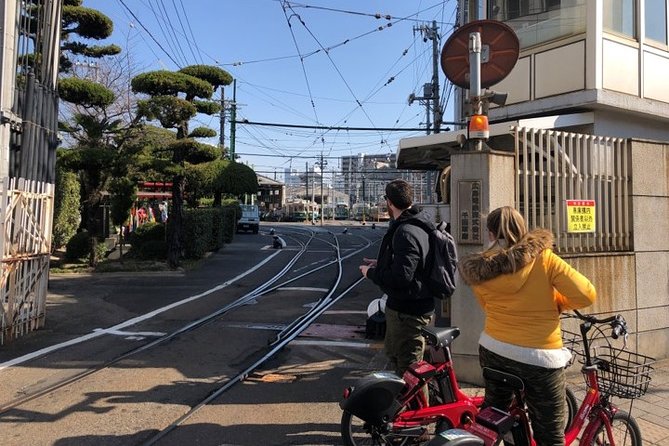
The route continues to Hiroshima’s railway area, about two to 2.5 kilometers from the blast center. Two trains survived the bombing and continued to be used, a striking reminder that the destruction had a wide reach but did not erase every part of the city’s infrastructure.
This is the kind of detail that makes the ride useful for first-time visitors. You can read about the bomb in a museum, but seeing the distance on a bicycle gives the geography a physical scale. You are not asked to imagine the city as one single destroyed zone. You see different levels of damage and the gradual return of movement.
The railway stop is brief, about 10 minutes. It works best as part of the larger sequence rather than as a stand-alone attraction.
Miyuki Bridge and the surviving weeping willow
At Miyuki Bridge and the Kobayashi River, the guide points out a photograph showing the boundary of the bomb’s reach. The location helps explain the difference between areas close to the center of the blast and places farther away.
The stop lasts roughly 10 minutes. It is another example of the tour’s emphasis on distance and comparison. The route does not stay only at the most famous memorials. It keeps asking you to look at how the city changed from one block or river crossing to the next.
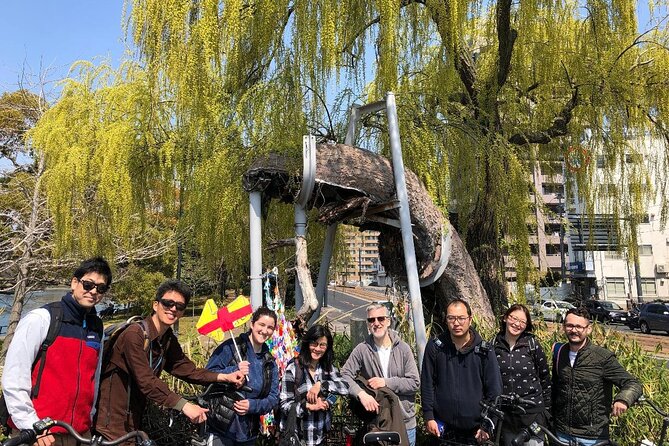
The final major stop is a surviving weeping willow tree near the Hiroshima City Children’s Culture and Science Museum. The tree continued growing despite the belief that natural growth would not return for decades. It has become a symbol of endurance and renewal.
This is described as a highlight, and I can see why. After several stops focused on destruction, the tree gives the route a living image of recovery. It is not a sentimental replacement for the harder history, but it offers a meaningful way to end the outward journey.
Returning along Peace Boulevard
The final ride follows Peace Boulevard back toward the park. You pass additional monuments and trees connected to Hiroshima’s story while also seeing the city as it functions now.
That return matters. The tour does not leave you only with images of ruins and suffering. You see schools, roads, rivers, parks, and a rebuilt city. The point is not to hide the past, but to show how Hiroshima has chosen to live with it and speak about it.
The morning tour returns to the Peace Park at 13:00. The afternoon version meets at 14:00 and finishes at 17:00. That leaves the rest of your day available for the Peace Memorial Museum, lunch, Miyajima, or time to process what you have heard.
The guides make the history personal
The most praised part of this experience is the guiding. Shin is frequently named, and his connection to Hiroshima’s bombing history has made a strong impression. His family stories help connect large historical events with ordinary lives, while his lively personality keeps the ride from becoming unrelentingly grim.
Moe, also written as Moet in one account, has shared that all four of her grandparents lived through the bombing. Kana has been described as clear and patient when answering questions. Toma and Thomas have also led departures, bringing their own explanations and local perspectives.
You should not book expecting one specific guide unless the operator confirms it. But you can reasonably expect a local guide who explains both the wartime events and the postwar rebuilding. The personal element is valuable, but it should be treated with respect. You are hearing family memories, not watching a performance.
English ability has been praised in the supplied information, including clear explanations and fluent communication from some guides. Still, the pace and exact storytelling will vary by guide and group.
Price, comfort, and who gets good value
At $85.89 per person, this is not the cheapest way to see Hiroshima. You are paying for the bicycle, electric assistance, guide, included admissions, bicycle accident insurance, and a three-hour route that reaches sites spread across the city.
I think the price makes the most sense if you want an organized introduction and would otherwise spend much of the day figuring out transport between scattered places. The guide adds the most value at the smaller sites, where a sign alone would not explain the connection to the bombing.
The tour suits adults, families with older children, and anyone comfortable on a bicycle. Adult electric bicycles require a height of at least 145 centimeters. Children between 110 and 145 centimeters can use one of the two children’s bicycles available for each booking, and children under 15 can use children’s or adult bicycles at the child rate. Electric bicycles with child seats are available for children under 22 kilograms and under 115 centimeters.
The bicycles have received one practical criticism: some riders found the e-bikes undersized. If you are tall, ask about bicycle fit when booking or at the meeting point. The bikes are described as easy to use, but comfort can depend on your height.
Weather, timing, and practical cautions
The tour requires suitable weather. If rain prevents the cycling route, you can switch to a rainy-day walking route or request a refund. The alternate route covers the Peace Memorial Park, Atomic Bomb Dome, hypocenter, former Bank of Japan, Fukuromachi Elementary School, and the main street, ending at 13:00 or 17:00 depending on your start time.
The timetable can change on the day. Arrive early at the Peace Park Rest House, because arriving late without prior notice can lead to cancellation with no refund. The standard cancellation rule allows a full refund if you cancel at least 24 hours before the start time. Changes or cancellations inside that window are not refundable.
There is no free Wi-Fi at the Rest House, though Hiroshima Free Wi-Fi is available around the city. The tour includes bicycle accident insurance, but you should still ride carefully and follow the guide’s instructions.
Should you book the three-hour route?
Book this tour if you want Hiroshima’s memorial sites placed into a wider city story. The three-hour version is especially useful if you want more than the Peace Park and Atomic Bomb Dome. Hiroshima Castle, Gokoku Shrine, the railway sites, Red Cross Hospital remnants, and the survivor tree add layers that a shorter route cannot cover.
Choose the two-hour option instead if you want a tighter visit focused mainly on the Peace Park, the bombing, and the rebuilt city. Choose the three-hour tour if you have the energy for a longer morning and want more time with a local guide.
I would book it early if the personal guide element matters to you, since the group is limited to 10 people and the tour has been booked frequently. Go with an open mind, leave room afterward for a quiet museum visit or meal, and expect the experience to stay with you longer than an ordinary sightseeing ride.
FAQ
Where does the Hiroshima Peace Cycling Tour begin?
It begins at the Hiroshima Peace Park Rest House in Hiroshima’s Naka Ward.
Where does the tour finish?
The cycling route returns to Hiroshima Peace Memorial Park and ends at the original meeting point.
How long is the tour?
The tour lasts approximately three hours. The morning departure runs from 10:00 to 13:00, and the afternoon departure runs from 14:00 to 17:00.
How large is the group?
The shared tour has a maximum of 10 people.
Are the bicycles electric?
The adult bicycles are electric bicycles. Children’s bicycles are also available in the sizes and quantities listed by the operator.
What height is required for an adult bicycle?
Adult electric bicycles require a height of at least 145 centimeters.
Can children join the tour?
Children can join. Children from 110 to 145 centimeters can use a children’s bicycle, with two children’s bicycles available for one booking. Children under 15 can use children’s or adult bicycles at the child rate.
Are entrance fees included?
Yes. Entrance fees listed for the included sites are covered in the tour price.
What happens if it rains?
You can change to a rainy-day walking route covering major Peace sites, the hypocenter, the former Bank of Japan, and Fukuromachi Elementary School. If you do not want the walking route, a refund is offered when the cycling tour cannot operate because of rain.
Can I store luggage at the meeting point?
There is no luggage storage at the Peace Park Rest House. Coin lockers are available at the International Conference Center Hiroshima and Hiroshima Peace Memorial Museum, about a six-minute walk away.
Just added around Japan
- Slow Cycling Tour at Uji’s Matcha Green Tea Fields and Heritage★ 5.0 · 25 reviews
- Tokyo Non-Touristy Local Private E-bike Cycling Tour from Asakusa★ 5.0 · 2 reviews
- 2.5 Hour-Guided Cycle Tour in the Central Tokyo★ 5.0 · 25 reviews
- Little Adventure with Cycling in Tokyo No. 1 Crystal Clear River★ 5.0 · 6 reviews
- Tokyo Night Bike Tour: From Shibuya to Tokyo Tower via Roppongi★ 5.0 · 29 reviews
- Tokushima & Mt. Bizan BROMPTON Slow Cycling Tour★ 5.0 · 5 reviews
- Tokyo’s hidden nature cycling tour – Okutama Historical Road Tour★ 5.0 · 6 reviews
- Wakimachi BROMPTON Slow Cycling Tour★ 5.0 · 5 reviews
Cycling Tours, compared.
Ninh Binh Day Trip: Hoa Lu-Trang An/Tam Coc-Mua Cave-Cycling-Boat
Read our review →
Cai Be Mekong Delta Tour: Cooking Class, Cycling & Craft Villages
Read our review →
Countryside Bike Tour from Amsterdam: Cheese, Clogs & a Windmill
Read our review →
Electric Cycling Tour of Ubud with Free Hotel Transfer and Lunch
Read our review →
Browse the lists this tour appears in