
Review · KYOTO
KIYOTO’s Kyoto Private E-Cycling Tour: Highlights & Hidden Gems
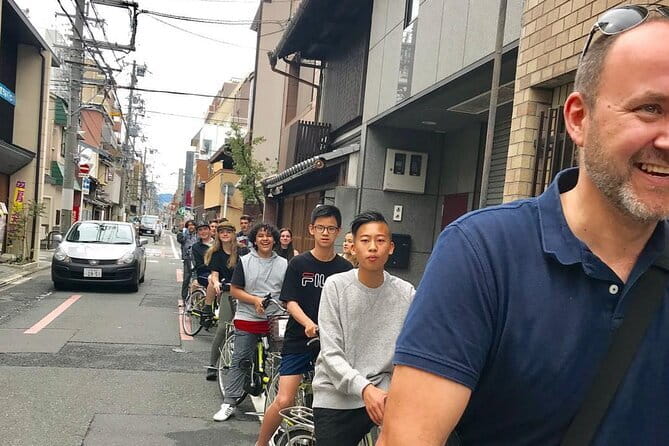
Kyoto’s best sights are spread across a wide area, and this private e-bike tour gives you a practical way to connect them. In one outing, you can ride from Fushimi Inari and Tofuku-ji through Gion, along the Philosopher’s Walk, and north to Shimogamo Shrine and the Kamogawa Delta. That is a lot of Kyoto in four to eight hours.
I like the private format, since your guide can slow down for a temple garden, skip a place you have already seen, or add a quieter neighborhood. I also like the comfortable electric bikes, which make Kyoto’s long distances far less tiring than walking. The main catch is that you need to be comfortable riding in city traffic, and a long list of stops can mean short visits at some sights.
- Fushimi Inari to Gion: Cover two of southern Kyoto’s major attractions without spending the day on trains and buses.
- Private route planning: Guides such as Yonnie, Yuhey, Yuichi, Mana, and Polina have tailored rides to family needs and places riders had not yet visited.
- Quiet Kyoto between the landmarks: Ride narrow backstreets, canal paths, and local areas around Shimogamo and the Kamo River.
- Included electric bike: Standard bicycles are also available, while children’s bikes and child seats are limited and must be requested.
- Strong guide element: Expect local customs, history, photo help, and careful navigation through crowded streets.
- A full-city outing: The route can run from four to eight hours, so you can choose a brisk highlights ride or a fuller day outside.
Why an E-Bike Works So Well in Kyoto
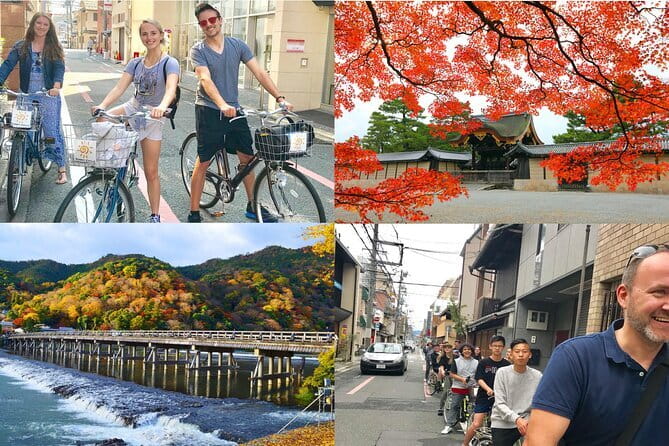
Kyoto looks compact on a map, but its sights stretch from the southern torii gates of Fushimi Inari to northern shrines and river junctions. Walking between those areas takes too much time. Public transport helps, but trains and buses do not always leave you near the entrance you want.
An e-bike solves much of that problem. You can cover more ground while still moving slowly enough to notice wooden houses, small shrines, river paths, and ordinary neighborhoods. The electric assist matters most late in the ride, when several hours of sightseeing would otherwise turn into a test of your legs.
This is not a race. The point is to connect a large number of places without wasting the day on transfers. The private setup also lets you adjust the balance between riding and sightseeing. If you want the major sights, your guide can keep the pace moving. If you prefer local streets and quieter temples, you can ask for more time away from the busiest stops.
The tour starts and ends at Sunny CycleJapan in central Kyoto, at 477 Ōhorichō, Shimogyo Ward. The meeting point is near public transportation, and the activity returns there at the end.
Fushimi Inari and Tofuku-ji Begin the Ride
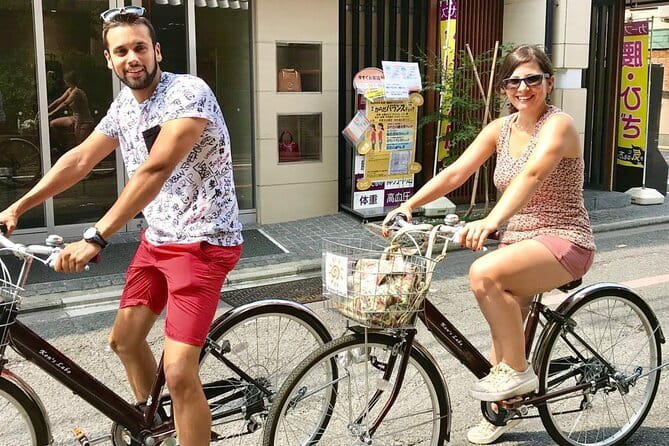
The southern section gives you an immediate taste of Kyoto’s famous religious sites. Fushimi Inari-taisha is known for its long rows of orange-red torii gates, which climb the wooded slopes behind the shrine. You are scheduled for about 40 minutes here, enough to see the lower shrine grounds and walk into the gate tunnels, though not enough to climb the full mountain route.
That time limit is worth understanding. Fushimi Inari can easily absorb half a day if you walk far uphill. On this tour, you are getting a focused visit, not a complete mountain hike. The bike lets you see the shrine and then continue to the next area instead of spending the morning on foot.
Komyo-in, a sub-temple of Tofuku-ji, brings a quieter mood. Its garden is associated with moss and seasonal foliage, especially in autumn. You have about 20 minutes here, and admission is not included, so bring money for the entrance fee if the temple is open and included in your guide’s route.
Tofuku-ji follows with a short stop of about 10 minutes. The temple is especially known for the Tsutenkyo Bridge and its views over maple trees. Autumn is the famous season, but the setting is still worth seeing outside peak color. The short visit means you should treat this as a photo and orientation stop rather than a full temple exploration.
More Private Cycling Tours in Japan
- 3-Hour Tokyo Private E-Bike Tour Starting from Your Hotel
★ 5.0 · 117 reviews - Private Afternoon Cycling Tour in Hida-Furukawa
★ 5.0 · 109 reviews - Private-group Morning Cycling Tour in Hida-Furukawa
★ 5.0 · 105 reviews
Gion’s Pagoda, Shrines, and Old Streets
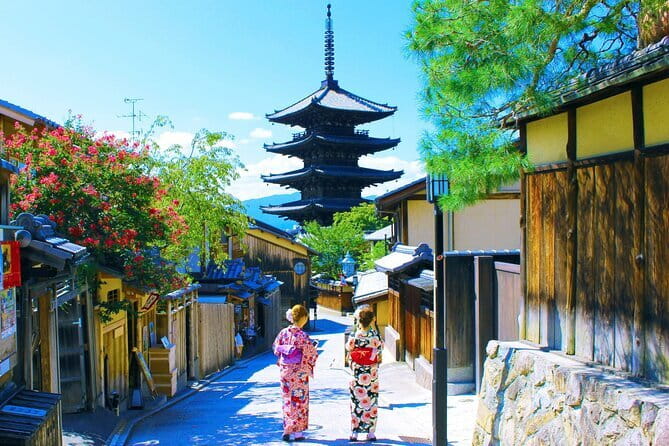
The ride then moves into eastern Kyoto, where the streets become more intimate and traditionally built. Hōkan-ji, better known as Yasaka Pagoda, gives you one of Kyoto’s most recognizable views. Its tall wooden pagoda rises above the Higashiyama district, and the surrounding lanes make a good photo stop.
The area can be crowded, so cycling here requires care. You may need to walk the bike in the busiest stretches, and your guide’s route choice matters. This is one reason a private tour is more useful than simply renting a bicycle and setting off alone.
At Yasui-Konpiragu, you’ll see a shrine associated with breaking harmful relationships and forming better ones. The large stone with a small opening is central to the shrine’s custom. The scheduled stop is only about 10 minutes, but the site adds a different layer to Kyoto’s religious life. It is less about grand architecture and more about personal wishes and everyday belief.
Hanamikoji Street leads into Gion, with traditional buildings, tea houses, and restaurants. The route gives you about 10 minutes here. That is enough to absorb the old-town atmosphere, but you should not expect a leisurely meal or a long search for geisha. Treat the street respectfully, keep your camera ready, and follow your guide’s advice about where cycling or photography is appropriate.
Tatsumi Bridge and the Shirakawa Canal offer a gentler side of Gion. The small bridge, willow-lined waterway, and traditional machiya buildings create one of the prettiest short stops in the city. The Shirakawa section gets about 15 minutes, followed by another 15 minutes at the river terrace. These pauses let you step away from the main road and hear the water moving through the district.
Heian Shrine and Nanzen-ji’s Waterway
The route continues toward the large vermilion torii of Heian Jingu. At 24.2 meters tall, the gate is difficult to miss and makes a strong approach from the street. The torii dates from 1929 and was built of reinforced concrete, a detail that helps explain why the structure looks ancient but is not an old surviving gate.
The stop is about 15 minutes and focuses on the gate rather than a full visit to the shrine grounds. If Heian Jingu is a priority for you, tell your guide early. The tour is flexible, but a fuller shrine visit would require more time than the listed stop.
Nanzen-ji gives you a taste of one of Kyoto’s major Zen temple areas. The temple dates to 1291 and is known for its gardens and broad grounds. The schedule allows roughly 15 minutes, so you’ll see the setting and key structures without having time for every garden and sub-temple.
Nearby, the Nanzenji Suirokaku aqueduct adds an unusual piece of modern-era history to the temple district. Built in 1888, the brick structure carried water from Lake Biwa. It is an unexpected sight beside the temple buildings, and the 10-minute stop is enough to appreciate its arches and take photographs.
These two stops work well together. Nanzen-ji shows Kyoto’s older religious tradition, while the aqueduct reflects the city’s later effort to move water and support urban growth. Your guide can connect those layers in a way that is hard to pick up from a quick photograph.
The Philosopher’s Walk and Honen-in
The Philosopher’s Walk follows the Biwa Canal for about two kilometers between the northern Higashiyama temple area and the vicinity of Ginkaku-ji. The tour allows around 30 minutes here. Depending on conditions and local rules, you may ride parts of the route or walk the bike along busier sections.
This is one of the more pleasant stretches of the outing because the pace naturally slows. Water, trees, small bridges, and side lanes replace the traffic of the main roads. In spring, the canal is especially popular for cherry blossoms. In other seasons, the route is still useful as a calm connection between major temple districts.
Honen-in is a smaller, quieter temple set among trees. The stop lasts about 15 minutes. It offers the sort of peaceful pause that can get lost on a sightseeing day built only around famous names. The grounds are associated with Honen Shonin, a major Buddhist figure, and the setting gives you a chance to step off the bicycle and enjoy a more subdued temple atmosphere.
The tradeoff is time. Thirty minutes at the Philosopher’s Walk and 15 minutes at Honen-in will not satisfy you if you want a slow garden visit or detailed temple study. The strength of this tour is range. You see many different parts of Kyoto rather than spending a whole afternoon in one complex.
More city cycling tours in Kyoto:
- Tokyo Top Highlights 3h Guided E-bike Tour
★ 5.0 · 714 reviews - 4-Hour Morning Cycling City Tour (incl. breakfast)
★ 5.0 · 407 reviews - Taipei: 4-Hour Morning City Cycling Tour with Breakfast
★ 4.7 · 275 reviews - Pula Highlights Bike Adventure
★ 5.0 · 254 reviews
Shimogamo Shrine and the Kamo River
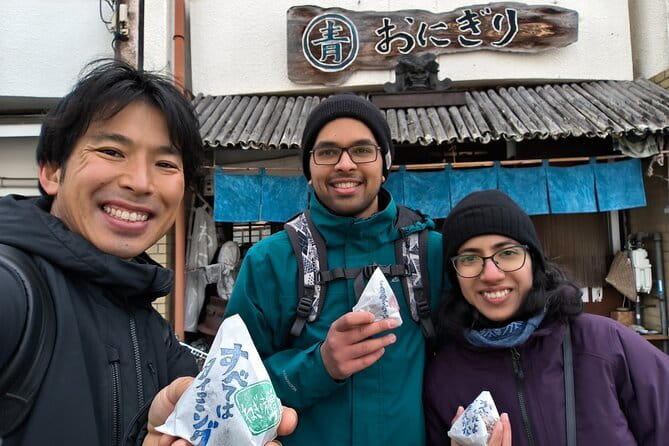
Shimogamo Jinja, formally Kamomioya Shrine, shifts the focus from Zen Buddhism to Shinto. It is considered one of the oldest shrines in the region, with roots traditionally reaching back to around 90 BC. The wooded approach and sacred atmosphere make it feel separate from central Kyoto, even though you are still within the city.
You have about 30 minutes here, which is one of the longer temple and shrine stops on the route. That gives you time to look at the shrine buildings, walk through the grounds, and ask your guide about Shinto customs.
The Kamogawa Delta comes next, where the Kamo and Takano rivers meet. Stepping stones shaped like turtles and birds cross the water, and the area is popular with local residents as well as visitors. You may find it a fun place for photographs and a short rest, especially after several hours of riding.
The river section also shows why an e-bike is useful in Kyoto. You are not simply moving from one ticketed attraction to another. You are connecting parks, waterways, residential districts, and major sights in one continuous route.
Northern Kyoto Stops and Central City Streets
The tour can also include Kyoto Gyoen, the broad park around the former Imperial Palace. It is an open green area with historic buildings, seasonal plants, and places where locals go to relax. The supplied route information does not give a fixed stop length here, so ask your guide how much time is available if the park is important to you.
At the Ebisugawa stepping stones, also called Ebisugawa Tobiishi, you can hop across a tributary of the Kamo River. This is a small, local-feeling stop rather than a major monument. It adds playfulness to the route and gives you a break from formal temple grounds.
Teramachi-dori brings you back into central Kyoto. The covered and street-level shopping area includes traditional goods, cafes, clothing shops, and everyday local businesses. You have about 10 minutes here, so it is more of a quick orientation than a serious shopping session. If you want time to browse, tell your guide before the ride begins.
Sanjo Street is another central connector, close to Kawaramachi and the Kamo River. It has restaurants, cafes, shops, and older buildings mixed into a busy city setting. These final central stops make the ride feel like a look at present-day Kyoto, not just a tour of preserved religious sites.
What Your Guide Adds to the Ride
The guide is an important part of the experience. The tour includes a passionate guide who can take photographs, explain local history and customs, and help you navigate Kyoto’s crowded streets. Previous guide names associated with this experience include Yonnie, Kento, Yuhey, Yuichi, Mana, Takuma, and Polina.
The strongest guide qualities are flexibility and care with families. Yuhey has been especially praised for keeping children engaged, while Mana has helped with questions before the ride and offered advice beyond Kyoto. Polina has led relaxed rides through narrow backstreets, and Yonnie has been noted for safe navigation and clear explanations of Japanese culture.
You should still tell the company what you want before the day. If you have already seen Fushimi Inari, want more time in Gion, or prefer quieter temples, the private format gives your guide useful direction. The more specific you are, the more useful the flexibility becomes.
Price, Pace, and Who Gets the Best Value
At $198.15 per person, this is not a cheap bicycle rental. The price includes the electric bike, guide, route planning, and a private experience for your group. The value improves when you compare it with the cost of arranging several separate taxi rides, navigating public transport, renting equipment, and researching a route that links far-flung sights.
I think the price makes the most sense for first-time visitors with limited time, families who want help managing the day, and couples or small groups who value a private pace. It is also useful if you want both famous sights and ordinary Kyoto streets without planning every turn yourself.
You should budget separately for food, drinks, and paid temple or shrine entry. Komyo-in is specifically listed as not including admission. The four to eight hour range is broad, so confirm the length you want when booking. A shorter outing will suit you if you mainly want the southern and eastern sights. A longer ride gives the route room for Shimogamo, the river areas, Kyoto Gyoen, and central shopping streets.
A moderate level of fitness is needed. You must be able to ride a bicycle, and you should be comfortable sharing roads with traffic. Standard bicycles are available, and children’s non-electric bikes can be requested, though supplies are limited. Child seats are also limited and must be requested in advance.
Should You Book KIYOTO’s Kyoto E-Cycling Tour?
Book it if you want to see a wide slice of Kyoto in one day and prefer moving through the city rather than waiting for buses. The private format, electric bikes, and guide-led route are the main reasons to choose it. You can cover Fushimi Inari, Gion, Nanzen-ji, the Philosopher’s Walk, Shimogamo, and the Kamo River without treating every transfer as a separate task.
Skip it if you dislike cycling in urban areas, need long visits inside each temple, or want a slow, single-neighborhood day. This ride favors variety and connection over deep exploration of one site.
For most active visitors, I would choose the longer option and ask for a route that balances major sights with quieter streets. Request a child bike or seat early if needed, and tell the guide which places you have already seen. With those small decisions, this becomes one of the most efficient ways to get your bearings in Kyoto while still seeing how the city works beyond its headline attractions.
FAQ
How long does the Kyoto private e-cycling tour last?
The tour lasts approximately four to eight hours. The exact pace and length can be adjusted because it is a private activity for your group.
Are electric bikes included?
Yes. An electric bike is included, and a normal bicycle is also available. Children’s bicycles are non-electric and limited, so request one when booking.
Can children join the tour?
Yes, children can join if they can ride a bicycle. Limited child seats are available for children who cannot ride independently, and you must request one in advance.
What is included in the tour price?
The price includes the bicycle and a private guide who provides local information and can take photographs. Food, drinks, and paid temple or shrine admissions are not included.
Where does the tour start and finish?
The tour starts at Sunny CycleJapan, 477 Ōhorichō, Shimogyo Ward, Kyoto, 600-8419. It ends back at the same meeting point.
Can I cancel the booking?
You can receive a full refund if you cancel at least 24 hours before the experience start time. Cancellations or changes made less than 24 hours in advance are not accepted for a refund.
More Private Cycling Tours in Kyoto
- Private Self-Guided E-Bike Ride in Tuscany with Vineyard Visit
★ 5.0 · 775 reviews - VIP Mekong Delta Adventure Cycling & Kayaking – Private Day Trip
★ 5.0 · 179 reviews - 3 Hour Sonoran Desert Private Guided Mountain Bike Tour
★ 5.0 · 154 reviews - 2 Hour Sonoran Desert Private Guided Mountain Bike Tour
★ 5.0 · 92 reviews
Just added around Kyoto
- Kyoto: Higashiyama Slow Cycling Tour along the quiet waterfront★ 5.0 · 10 reviews
- City cycle (no gear change)★ 3.5 · 5 reviews
- Rent a Road Bike to Explore Kyoto and Beyond★ 5.0 · 2 reviews
- Explore Hidden Alleyway with a Local Expert (Afternoon Tour)★ 5.0 · 17 reviews
- Kyoto Shogun Cycling Tour★ 5.0 · 13 reviews
- Cycle Kyoto’s Hidden Gems & Gion Stroll★ 5.0 · 8 reviews
- Ine Funaya e-BIKE Cycling Tour★ 4.0 · 2 reviews
- Kyoto Satoyama Cycling with Lunch and English guide★ 5.0 · 4 reviews
City Cycling Tours, compared.
4-Hour Morning City Cycling Tour with Breakfast
Read our review →

Guided City Cycling Tour – Culture, Colors & Charm
Read our review →
Barcelona Highlights Bike Tour: Cycle along the beach!
Read our review →
Bike or E-Bike Tour Tirana: Highlights & Grand Park Guided Cycle
Read our review →Browse the lists this tour appears in