
Review · MARRAKECH
Cycling Adventure in Marrakech
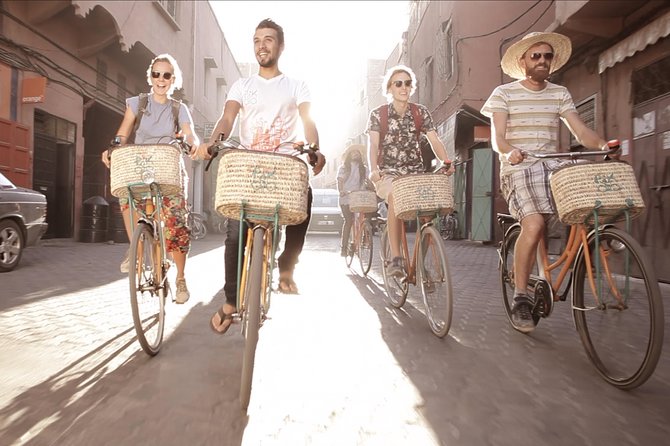
Marrakech makes more sense from a bicycle seat. With Pikala Bikes, you move from the Medina’s tight lanes to the wider streets of Gueliz, passing grand sights, working neighborhoods, a public bakery, a hammam, and a second-hand market. Guides such as Yasser, Hamit, Khawla, and Zouhair add personal stories about family, religion, and growing up in Morocco.
I like two things here. First, the route looks beyond the postcard sights and shows you places tied to ordinary life. Second, the tour supports Pikala, a local non-profit project that trains young Moroccan guides. The main caution is traffic: cycling in Marrakech takes attention, confidence, and a willingness to handle sudden movement from several directions.
Key points to know before you book
- A three-hour look at everyday Marrakech: The route includes the Medina, Gueliz, the Koutoubia, Kasbah, Agdal gardens, a bakery, hammam, market, and local neighborhoods.
- Young Moroccan guides lead the ride: Guides including Yasser, Hamit, Khawla, Mo, and Zouhair share personal stories as well as city facts.
- You ride through real city traffic: Narrow lanes, pedestrians, scooters, and changing road conditions make the ride exciting but not relaxing.
- Small local stops give the tour its character: Expect bread or sweets, juice, bottled water, and a cafe stop at the cross-cultural Cafe Clock.
- The ride starts and ends at the same address: Meet at 29 Rue Riad Laarous in Marrakech. The group can include up to 20 people.
- The price is moderate for a three-hour experience: At $33.28 per person, the tour offers transport by bicycle, guiding, tastings, and a social purpose.
Why a bicycle works so well in Marrakech
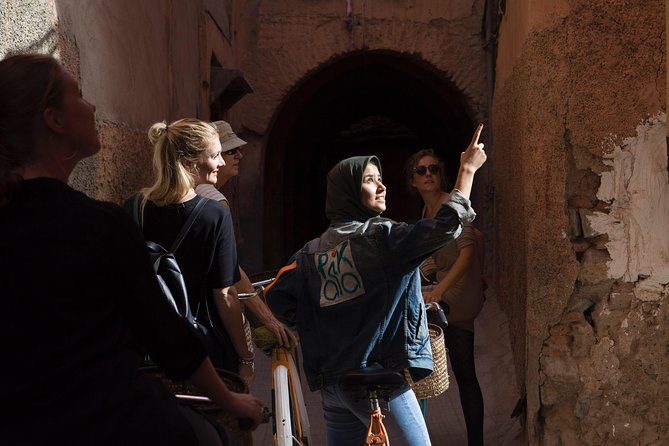
Marrakech is a city of contrasts. One moment you are near the Koutoubia, the city’s famous mosque and minaret. A few turns later, you are watching local commerce unfold in a lane that most sightseeing routes skip.
Walking gives you time to notice details, but a bicycle lets you cover more ground. You can connect the historic Medina with newer Gueliz and reach areas that feel far removed from the main square. That wider view is the point of this tour.
Pikala does not frame Marrakech only through palaces and monuments. The route brings you into contact with working parts of the city: a public bakery, a traditional hammam, local trades, markets, and neighborhood streets. You get context for how the city functions, not just a list of buildings to photograph.
The social purpose matters, too. Pikala trains young Moroccan guides, giving them a role in presenting their city to visitors. That makes the conversation feel more personal. Guides have spoken about childhood, family expectations, religion, and the changes brought by modern life. Those subjects give the ride more depth than a standard sightseeing loop.
A few more rides around Marrakech worth a look
- Dutch Bike Tour in Marrakech with Local Guide
★ 4.7 · 269 reviews - Marrakech:Guided City Cycling Tour – Culture, Colors & Charm
★ 4.7 · 231 reviews - Marrakech’s Best Cycling Tour: Culture, Colors, and Charm
★ 5.0 · 154 reviews
Starting at 29 Rue Riad Laarous
The tour begins at 29 Rue Riad Laarous, in the Medina area. You receive confirmation when booking, and the meeting point is near public transportation.
At the start, expect to get set up with a bicycle and meet your guide and group. The maximum group size is 20 people, though the feel of the ride can depend on the number who actually attend and how the guides manage the streets.
The bicycles deserve a realistic note. Several riders have found the bikes easy and modern, while one strong criticism concerned bicycle condition and fit. If the bike does not feel right, speak up before leaving. A poor saddle or awkward fit becomes more irritating once you are negotiating narrow streets.
You do not need to be a professional cyclist, but you should feel comfortable steering, braking, and keeping alert around traffic. The route is not a gentle ride through empty park paths. Your attention belongs on the road, even while the city keeps offering distractions.
Through the Medina, where the ride gets lively
The historic Medina is the most demanding part of the route and also the most memorable. Its lanes can be narrow, crowded, and full of movement. Scooters, pedestrians, bicycles, and other vehicles may appear from different directions, so you need to follow the guide closely and leave enough space to react.
This is where the ride can feel like a small adventure rather than a sightseeing transfer. You pass through streets that are difficult to understand from a taxi window. The bicycle places you close to workshops, neighborhood activity, and the everyday flow of the old city.
Your guide will make frequent stops. Use them. They give you time to take photographs, ask questions, and regroup. The strongest part of the experience is not racing from one sight to the next. It is stopping long enough to understand what you are seeing.
If you are an uncertain cyclist, the Medina may feel stressful. One rider described the experience as unsuitable for someone who is not very confident on a bicycle. That is fair advice, especially in hot weather or at especially busy times. I would choose this tour only if you can stay calm when the street becomes confusing.
The Koutoubia, Kasbah, and Agdal gardens
The route includes several of Marrakech’s better-known sights, including the Koutoubia, Kasbah, and Agdal gardens. These stops help connect the city’s grand public image with the neighborhoods around it.
The Koutoubia is an easy point of reference in Marrakech. Seeing it during a bicycle route gives you a useful sense of how the old city is organized around major landmarks. The Kasbah adds another historic layer, while the Agdal gardens provide a change from dense streets and built-up lanes.
The tour does not appear to be designed as a long formal lecture at each monument. Instead, these places are part of a moving story about Marrakech. You see the landmark, hear some explanation, then continue into areas where daily routines matter more than famous facades.
That balance is a major strength. If you want detailed architectural history at every stop, book a specialist history tour as well. If you want a broader understanding of how the historic and newer parts of Marrakech connect, this ride does the job in a more active way.
Same roads, a different day in the saddle:
- Marrakech: Cycling Tour in Palm Groove with Local Breakfast
★ 4.7 · 73 reviews - Marrakesh: Toubkal National Park Mountain Bike Trip w/Lunch
★ 4.4 · 63 reviews - E-Bike Day Trip From Marrakech To the Atlas Mountains
★ 5.0 · 27 reviews - E-bike day tour Atlas Mountains from Marrakech
★ 4.5 · 17 reviews
A bakery, hammam, and the work behind the city
The public bakery is one of the tour’s most useful stops. It shows a trade that serves local households rather than tourists. A visit like this helps you notice the shared services built into neighborhood life.
The traditional hammam offers another look at local custom. It is an old-style public bathhouse, and the stop gives your guide a natural opening to discuss social habits and daily routines. You may also see a tile-making or zellij workshop, depending on the route and the day.
These visits matter because they move the tour away from passive sightseeing. You are not simply looking at Marrakech. You are being shown places where people work, prepare food, meet one another, and maintain long-standing customs.
The exact order can vary, so do not treat the route like a timed museum itinerary. The guides may pause to answer questions, manage the group, or adjust the path through the streets. That flexibility is useful in a city where conditions change quickly.
Market streets and Gueliz
The route also reaches a large second-hand market and the newer district of Gueliz. These two parts of the ride help show how broad Marrakech really is.
The market offers a look at buying and selling outside the polished shopping streets. It is a good place to notice the difference between items made for daily use and goods aimed at the visitor trade. Your guide can provide the local setting, while you take in the sound, movement, and variety of the stalls.
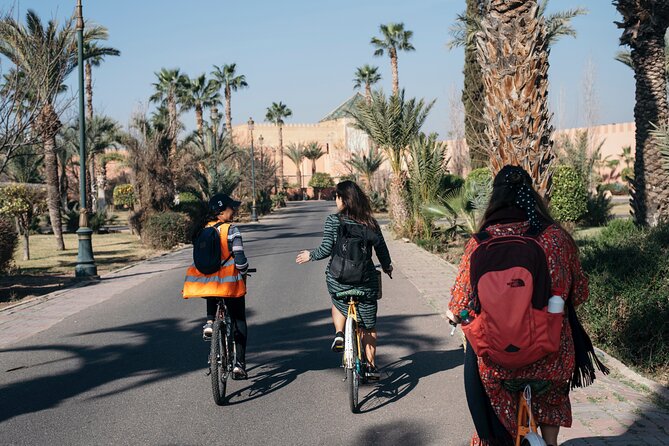
Gueliz feels different from the Medina. Streets are wider, the riding can feel easier, and the city has a more modern face. Several riders especially enjoyed this contrast, finding the newer district calmer and simpler to cycle through.
The switch between the two areas is one of the best reasons to choose a bicycle. You feel the change under your wheels. The Medina demands care and patience, while Gueliz offers more room to ride and look around.
Snacks, Cafe Clock, and a slower finish
Food stops are simple but well chosen. The tour includes juice, sweets, bottled water, and a stop at Cafe Clock, a cross-cultural cafe. Some rides have included bread or cookies and iced tea, with time to sit, talk, or play cards.
These breaks do more than provide refreshments. They give the group a chance to slow down after the more intense cycling sections. They also create space for informal conversation with the guide. That is often when you can ask about family, school, religion, modern life, or the practical details you noticed on the route.
The food is not the reason to book the tour, and you should not expect a full meal. Think of it as a welcome pause and a small taste of local hospitality. The included water is especially useful in warm conditions.
The ride finishes with a visit to the tomb of one of the seven Saints of Marrakech, then returns to the starting point. This closing stop adds a religious and local dimension to the route, though the tour is not presented as a formal religious visit.
The guides make the difference
Pikala’s strongest feature is its young Moroccan guides. Yasser has been praised for explaining local life clearly. Hamit has been described as friendly, patient, and willing to leave time for questions. Khawla has shared stories from her childhood and brought a warm personal touch to the ride.
Zouhair has led groups in English and handled changing group needs with quick thinking. Mo has added interesting facts and a playful atmosphere, while guides such as Achmed have helped make the ride feel conversational rather than scripted.
Your exact guide will shape the tone of the experience, but the format gives the guide room to talk about lived experience. You are not just hearing dates and names. You are hearing how family, religion, and modernization fit into Moroccan life.
The guides also manage the practical challenge of cycling together. Pay attention when they signal a turn or ask the group to stop. If your group includes different language levels or cycling abilities, the guide may divide people briefly or adjust the pace.
Price, timing, and who gets good value
The price is $33.28 per person for about three hours. That is fair value if you want more than a basic city ride. The cost includes the guide, bicycle, stops, snacks, juice, and bottled water, along with support for Pikala’s non-profit work.
You are also paying for access to a route that would be difficult to create alone. Finding a public bakery, hammam, local market, and neighborhood streets independently would take time and confidence. A guide helps you reach those places while explaining what they mean.
Morning and afternoon departures are available. Your choice may affect how the ride feels, but no fixed temperature or traffic guidance is provided, so choose the time that fits your schedule and energy best.
This is not the right value for you if you want a quiet ride, a luxury bicycle, or a private guide. It is a good buy if you want to cover several parts of Marrakech, meet a local guide, and support a social project in one outing.
Practical advice for a smoother ride
Wear clothes that let you move easily and shoes suitable for pedaling. You will want your hands free, so use a small bag rather than carrying loose items. Bring patience for the Medina and take the safety instructions seriously.
Check the bicycle before setting off. Confirm that the saddle feels usable and that the brakes and steering feel comfortable. If something seems wrong, ask the staff to adjust it at the start rather than hoping it will improve later.
Stay close to the guide and use every regrouping stop. The route can become challenging when traffic comes from several directions. You will enjoy it more if you treat the cycling as part of the experience, not as a race.
The tour is suitable for most people who can cycle, but the supplied information does not promise special accessibility arrangements. If you have mobility concerns, contact Pikala Bikes before booking.
Should you book the Pikala cycling tour?
Book it if you want to see Marrakech through local streets, hear personal stories from young Moroccan guides, and visit places tied to ordinary life. The combination of the Medina, Gueliz, markets, bakery, hammam, snacks, and Cafe Clock gives you a fuller picture than a monument-only tour.
Skip it if cycling in heavy city traffic makes you anxious or if you need a very relaxed pace. This ride can be exhilarating, but it demands alertness, especially in the Medina.
For confident cyclists who want an active, human view of Marrakech, Pikala Bikes offers excellent value. Choose a morning or afternoon departure, allow about three hours, and cancel at least 24 hours ahead if your plans change. Free cancellation is available until that point.
FAQ
How long does the Marrakech cycling tour last?
The tour lasts approximately three hours.
Where does the tour start?
It starts at 29 Rue Riad Laarous, Marrakesh 40000, Morocco.
Where does the tour finish?
The activity ends back at the meeting point.
What areas of Marrakech does the tour visit?
The route includes the historic Medina, the newer Gueliz district, the Kasbah, the area around the Koutoubia, and the Agdal gardens.
Does the tour visit local businesses and neighborhood sites?
Yes. The route includes a public bakery, a traditional hammam, a large second-hand market, and may include a tile-making or zellij workshop.
Are food and drinks included?
Juice, sweets, snacks, and bottled water are included. Stops have included bread, cookies, and iced tea.
Is this tour suitable for all cycling abilities?
Most people can participate, but the route includes busy streets, narrow Medina lanes, and traffic from several directions. You should be comfortable cycling in those conditions.
How many people can join the tour?
The maximum group size is 20 people.
Are morning and afternoon departures available?
Yes. You can choose between a morning or afternoon departure.
What is the cancellation policy?
You can cancel up to 24 hours before the local start time for a full refund. Cancellations or changes made less than 24 hours before the start time are not accepted for a refund.
Just added around Marrakech
- The Palmery Off-Road Bike Tour from Marrakech★ 5.0 · 5 reviews
- Full Day Private Mountain Bike Trip in the Atlas Mountains★ 5.0 · 4 reviews
- Atlas mountain bike★ 5.0 · 2 reviews
- E-Bike Day trip from Marrakech to atlas Mountain imlil valley★ 5.0 · 2 reviews
- Atlas Mountains Beginners Mountain Biking Tour from Marrakech★ 5.0 · 14 reviews
- E-bike day tour Atlas Mountains from Marrakech★ 4.5 · 17 reviews
- E-Bike Day Trip From Marrakech To the Atlas Mountains★ 5.0 · 27 reviews
- Beginners On-Road Bike Tour of the Atlas Mountains from Marrakech★ 5.0 · 4 reviews
Cycling Tours, compared.
Ninh Binh Day Trip: Hoa Lu-Trang An/Tam Coc-Mua Cave-Cycling-Boat
Read our review →
Cai Be Mekong Delta Tour: Cooking Class, Cycling & Craft Villages
Read our review →
Countryside Bike Tour from Amsterdam: Cheese, Clogs & a Windmill
Read our review →
Electric Cycling Tour of Ubud with Free Hotel Transfer and Lunch
Read our review →
Browse the lists this tour appears in