
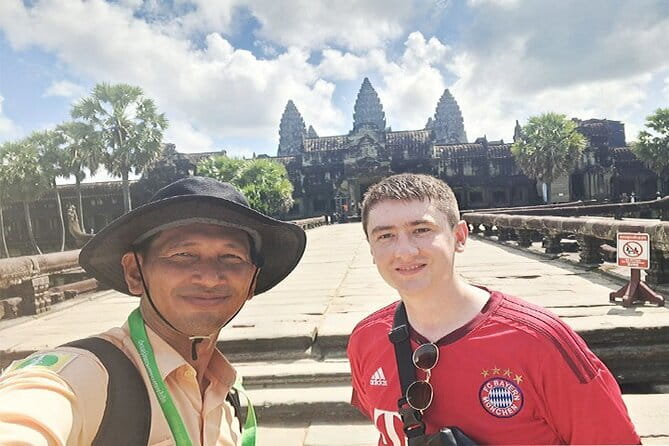
Review · SIEM REAP
Angkor Wat Cycling Tour With local Tour Guide from Siem Reap
The best part of this tour is the way a bicycle lets you move between Angkor’s major temples without spending the day sealed inside a car. You get fresh air, local roads, and a closer look at the countryside around Siem Reap, then pause at Angkor Wat, Bayon, Ta Nei, and Ta Prohm. Guide Thy is one named guide associated with the experience, praised for making the temple stories easy to follow.
I like the practical setup: hotel pickup, bicycle, helmet, bottled water, and drop-off are included. I also like the mix of famous and quieter stops, especially Ta Nei, where you get a break from the main temple circuit and time for fresh fruit. The main catch is that your temple admission ticket, food, drinks, and tip are extra, and eight hours of cycling in Cambodia’s heat will require a fair level of fitness.
Key points to know before booking
- Four major temple stops: Angkor Wat, Bayon, Ta Nei, and Ta Prohm give you both headline sights and a quieter forest setting.
- Cycling adds freedom: You travel under your own power instead of watching the temples through a vehicle window.
- A local English-speaking guide leads the day: Guide Thy is specifically praised for clear history and an enjoyable manner.
- The tour is private: Only your own group participates, so the pace can feel more personal than a large group outing.
- Tickets are not included: Budget separately for Angkor temple admission, meals, drinks, and a tip.
- Hotel pickup begins around 7:30 am: The full outing lasts about eight hours and ends back at the meeting point in Siem Reap.
Why cycling works so well at Angkor
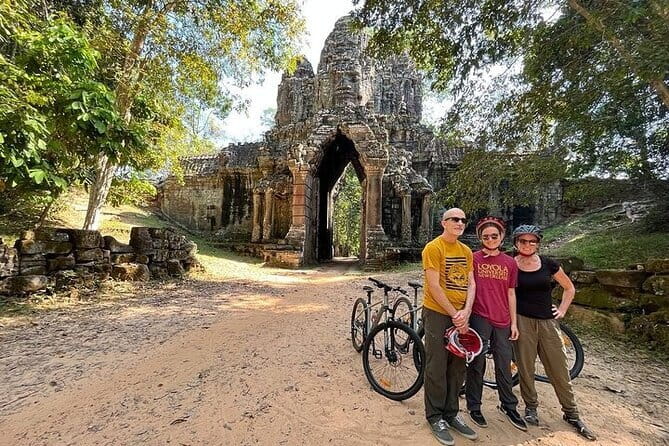
Angkor is not one building. It is a large collection of temples spread across roads and forest near Siem Reap. A bicycle makes the distance part of the experience rather than dead time between stops.
I like cycling here because you can notice more than you would from a car. You may catch glimpses of village life, roadside vegetation, and local paths as you move between the monuments. The ride also gives you a better sense of how the temples relate to one another within the old Khmer capital.
This is not a short ride followed by a quick temple visit. The activity lasts about eight hours, with roughly five hours listed for the main stops. The rest of the day allows for cycling, pickup, ticket arrangements, pauses, and movement around the temple area.
You receive a bicycle and helmet, plus bottled water. Those basics matter. You will be outside for much of the day, and the helmet is an important part of making the ride feel properly organized. Bring suitable clothing, sun protection, and extra water if you prefer to drink often. The tour includes a village donation, which adds a small local benefit to the day.
A few more rides around Siem Reap worth a look
- Siem Reap: Guided Countryside Bike Tour
★ 4.9 · 294 reviews - Cycle the Angkor Backroads with lunch / E-Bike or Tuk Tuk
★ 5.0 · 124 reviews - Floating Village Bike & Boat Sunset / E-Bike Available
★ 5.0 · 78 reviews
Starting at Angkor Wat around 7:30 am
Pickup from your hotel in Siem Reap is scheduled for about 7:30 am. The first practical stop is the ticket booth, where you buy the admission ticket needed for the temples. Admission is not included in the $31.50 tour price, so keep that cost separate when comparing this outing with other Angkor options.
Angkor Wat receives about two hours. That is enough time for an informed introduction and a focused visit, but it is not an unlimited exploration of every corridor and detail. Your guide can help you use the time well, pointing out major carvings, architectural features, and the temple’s place in Khmer culture.
Angkor Wat was built in the 12th century and is often described as the world’s largest religious monument. The scale can be hard to grasp at first. From the approach, the towers and galleries create a grand first view, but the details reward slower attention. Look at the carved scenes, the long galleries, and the way the temple is arranged around its central towers.
The guide’s role matters most here. Without context, Angkor Wat can become a series of impressive stone walls. With an English-speaking local guide, you can connect the art, architecture, and religious purpose instead of simply taking photographs and moving on.
The two-hour limit is also worth noting. If Angkor Wat is your main reason for coming to Cambodia, you may want a longer private visit on another day. For a one-day cycling tour, though, this stop gives you a strong first look before moving deeper into the old capital.
Bayon and the south gate of Angkor Thom
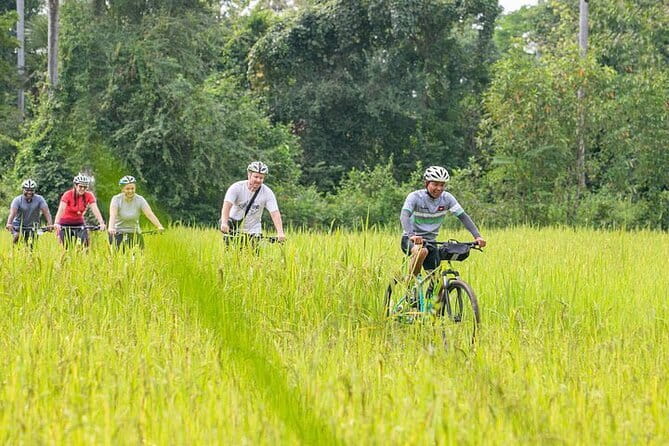
After Angkor Wat, the route continues to the south gate of Angkor Thom and then to Bayon Temple. The Bayon visit lasts about an hour and a half, making it one of the longer stops on the schedule.
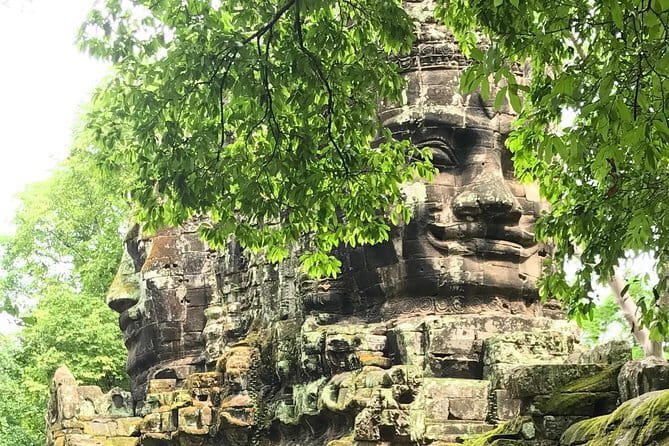
Bayon is known for its huge stone faces, identified here with Avalokiteshvara, and for its role as the state temple of the Mahayana Buddhist king Jayavarman VII. The faces appear from different angles as you move through the temple. This is a place where a guide can point out details you might otherwise miss.
I like the change in mood from Angkor Wat to Bayon. Angkor Wat feels ordered and monumental, while Bayon is more enclosed and visually surprising. Towers rise close together, corridors turn in unexpected ways, and carved stone faces watch from above.
The south gate is part of the approach to Angkor Thom, the ancient capital city linked to the prosperous Khmer Empire. You get more than a temple photograph here. The route introduces the old city’s scale and helps you understand that these monuments once belonged to a much larger urban and religious center.
The Terrace of the Elephants is also included during this part of the visit. It served as a royal viewing platform where the king could observe elephant training. The terrace gives you a chance to connect ceremonial architecture with the daily and military life of the royal court.
Because Bayon and the Terrace are open-air historic sites, expect uneven stone surfaces and plenty of walking once you leave the bicycle. The exact balance between riding and exploring will depend on the guide and the pace of your group, but the day is not a bicycle-only activity. You need comfortable footwear as well as a workable bike.
A quieter pause at Ta Nei
Ta Nei receives about 30 minutes. That is a short stop, but it changes the rhythm of the day.
The temple sits along a forested trail and is presented as a less frequently visited ruin. Its appeal is not grand scale. Instead, you get a more weathered setting, a sense of stone being reclaimed by the surrounding trees, and a welcome pause from the main monuments.
The tour includes time to relax and enjoy local fresh fruit. That small break may be one of the most useful parts of the route. After several hours of riding, heat, and temple steps, a pause gives you a chance to cool down and reset before Ta Prohm.
You should keep your expectations sensible. Thirty minutes is enough for a look and a rest, not a long archaeological study. Ta Nei is best understood as a quieter interlude that shows another side of the Angkor area.
This stop also highlights why a bicycle route can feel different from a standard car circuit. You are not only moving from one famous monument to the next. You are using trails and roads that make the spaces between temples part of the day.
Same roads, a different day in the saddle:
- Angkor Sunrise Expedition Cycling Through Serene Backroads
★ 5.0 · 70 reviews - Siem Reap: Countryside Cycle and Local Village Life Tour
★ 4.7 · 32 reviews - Short Cycling at Countryside
★ 5.0 · 29 reviews - Small Group Sunset, Picnic & Countryside, Bike Tours
★ 5.0 · 29 reviews
Ta Prohm and the power of the forest
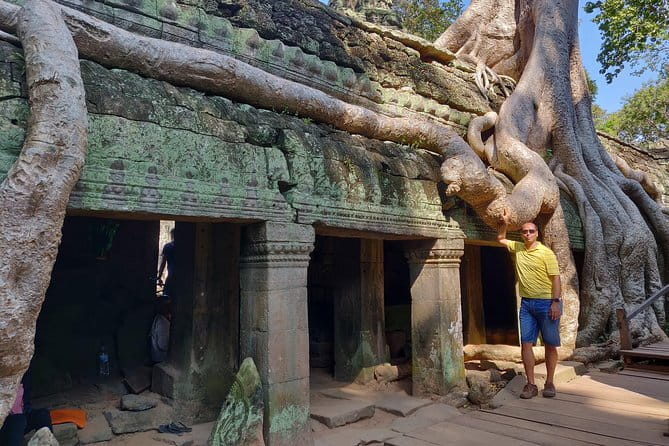
The final major temple stop is Ta Prohm, with about one hour set aside for the visit. This is one of the most recognizable temples in the Angkor area because kapok trees grip the stone structures with enormous roots.
Ta Prohm was left in the condition in which it was found, at least in the broad sense presented by the tour. Roots clasp walls, towers appear through foliage, and fallen stones show the long effect of weather and time. The contrast between masonry and trees gives Ta Prohm a very different character from the carefully ordered spaces of Angkor Wat.
I would save some energy for this stop. The temple is visually dramatic, but the walking surface can be rough and the heat can build by late morning or afternoon. Your guide can help you focus on the strongest views during the one-hour visit rather than trying to inspect every corner.
Ta Prohm also provides a useful final chapter for the day. At Angkor Wat, you see the Khmer Empire’s control of form and space. At Bayon, you see a more complex religious and royal setting. At Ta Prohm, you see how the forest interacts with the ruins when nature is allowed to press close.
What the guide adds to the day
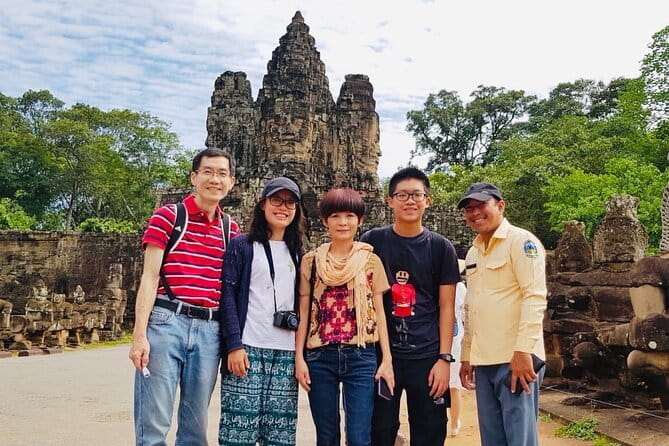
The tour is built around a professional English-speaking guide, not simply a bicycle rental. That distinction affects the value. The temples are powerful on their own, but their meaning is easier to grasp when someone explains the kings, religious changes, carved figures, and purpose of each site.
One named guide, Thy, is praised for making the history interesting and for showing the main temples thoroughly. That is useful information if you are trying to decide what kind of guiding style you want. The experience appears suited to someone who wants conversation and explanation, not just directions from one monument to the next.
This is a private activity, so only your group participates. That can make a difference at the temples. You are not tied to a large group’s pace, and you can ask for clarification when a detail catches your attention. The supplied information does not promise a fully customizable schedule, so I would still confirm any major timing request before the morning begins.
A guide can also help with the practical side of cycling. The route includes roads and trails, and the guide is the person you rely on for directions, pauses, and movement through the temple area. The exact bike model, riding distance, and level of traffic are not specified, so ask if those details matter to you.
What the $31.50 price really covers
At $31.50 per person, the tour offers a useful bundle: hotel pickup and drop-off, a bicycle, helmet, bottled water, an English-speaking guide, and a village donation. For a private day that combines transport logistics, equipment, guiding, and four temple stops, that is a reasonable starting price.
The low headline price needs context. You still pay for temple admission, food, drinks, travel insurance, personal expenses, and your guide’s tip. The ticket cost is the most important extra because it is required for the main sites.
The price is strongest for people who want an active day and would otherwise need to arrange a bicycle, route, guide, and transport separately. It is less attractive if you mainly want a short visit to Angkor Wat, dislike cycling, or expect lunch and admission to be included.
Food is not listed as part of the package, although the route does include fresh fruit at Ta Nei. Plan for your own meal and drinks rather than assuming the tour price covers them. You can also treat the fruit pause as a light refreshment, not a substitute for lunch.
Group discounts are available, but the amount is not specified. If you are booking for several people, check the final total rather than assuming a fixed percentage reduction.
Who should book this bicycle tour?
I would choose this experience if you want to see the famous temples while staying active. It suits couples, friends, and private groups who like to ride, enjoy fresh air, and prefer a guide-led day to arranging every detail themselves.
It also suits active older adults who are comfortable on a bicycle. One account connected with the experience describes a couple in their 60s who enjoyed cycling as a faster option than walking while still being outdoors. That does not mean the route is effortless. You should be comfortable riding for much of the day in warm conditions.
This tour may not suit you if you have limited mobility, are uncomfortable on a bicycle, or want long, unhurried time at every temple. The schedule covers four major stops in one day, so the outing has a steady pace.
The information says most people can participate and that service animals are allowed. It does not give detailed accessibility information for the temple surfaces, bike sizes, or transfers. Ask the provider directly if you need specific equipment or route adjustments.
Timing, packing, and small practical matters
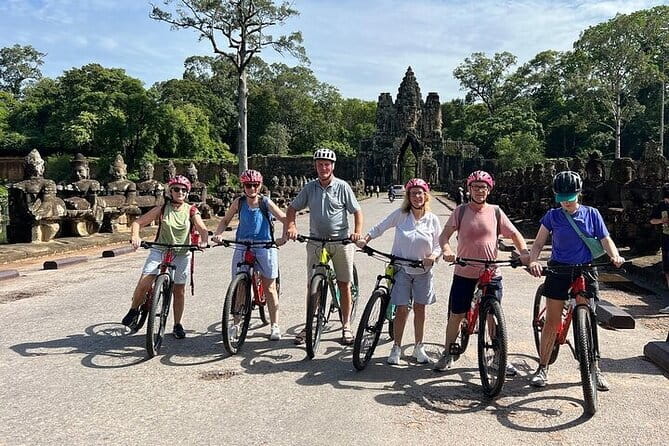
The day begins at about 7:30 am with hotel pickup in Siem Reap and ends back at the meeting point. The activity lasts approximately eight hours. Since the morning includes ticket purchase, cycling, temple walks, rest time, and several stops, do not treat the listed stop durations as the complete time spent outdoors.
Bring clothing suitable for a long day outside, comfortable footwear for uneven temple surfaces, sun protection, and money for admission, food, drinks, and a tip. Bottled water is supplied, but an extra personal supply may be useful.
The tour has free cancellation if you cancel at least 24 hours before the start time. Cancellations or changes made less than 24 hours ahead are not accepted for a refund, and the cut-off follows local time.
Should you book it?
Book this tour if you want a private, active way to cover Angkor Wat, Angkor Thom, Bayon, Ta Nei, and Ta Prohm in one day. The combination of a bicycle, local guide, hotel service, fresh fruit stop, and quieter temple trail gives you more texture than a simple car transfer between monuments.
Skip it if you want a slow temple study, a fully inclusive price, or a relaxed day with little physical effort. At $31.50 before admission and meals, it offers good practical value for an active visitor, but you need to budget for the extras and arrive ready to ride.
FAQ
How long does the Angkor Wat cycling tour last?
The tour lasts approximately eight hours, including hotel pickup, cycling, temple visits, rest time, and the return to the meeting point.
What time does hotel pickup begin?
Pickup is scheduled for approximately 7:30 am from your hotel in Siem Reap.
Which temples are visited?
The route includes Angkor Wat, Bayon Temple, Ta Nei Temple, and Ta Prohm Temple. It also visits the south gate of Angkor Thom and the Terrace of the Elephants.
Is the Angkor temple admission ticket included?
No. The admission ticket is not included. You buy the ticket at the ticket booth before visiting the temples.
Are bicycles and helmets provided?
Yes. A bicycle and helmet are included in the tour.
Is food included in the price?
No. Food and drinks are not included. The itinerary does include time to enjoy local fresh fruit at Ta Nei.
Is this a private tour?
Yes. Only your own group participates in the activity.
Can I cancel for a full refund?
Yes, if you cancel at least 24 hours before the experience start time. Cancellations or changes made less than 24 hours before the start time are not accepted for a refund.
Just added around Siem Reap
- Short Cycling at Countryside★ 5.0 · 29 reviews
- Small Group Sunset, Picnic & Countryside, Bike Tours★ 5.0 · 29 reviews
- Ruins Temples of Beng Mealea Cycling Tour★ 5.0 · 2 reviews
- Morning Village & Countryside Bike Experience – Siem Reap★ 5.0 · 5 reviews
- Phnom Krom for Sunset Cycling Tour★ 5.0 · 3 reviews
- Private Siem Reap Countryside Cycling Tour★ 4.5 · 4 reviews
- 1-Day Angkor Wat Cycling Tour: Scenic Bike Adventure in Siem Reap★ 5.0 · 9 reviews
- Half-Day Countryside Local Village Cycling Tour★ 5.0 · 13 reviews
Cycling Tours, compared.
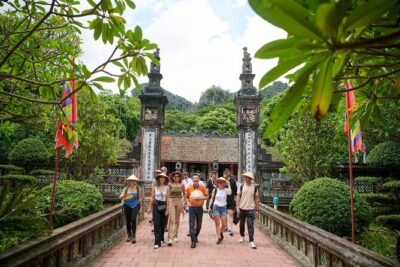
Ninh Binh Day Trip: Hoa Lu-Trang An/Tam Coc-Mua Cave-Cycling-Boat
Read our review →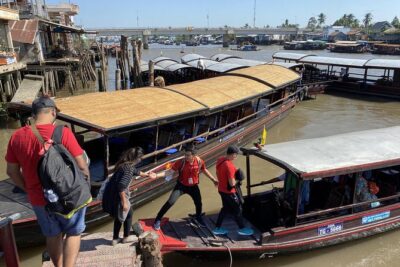
Cai Be Mekong Delta Tour: Cooking Class, Cycling & Craft Villages
Read our review →
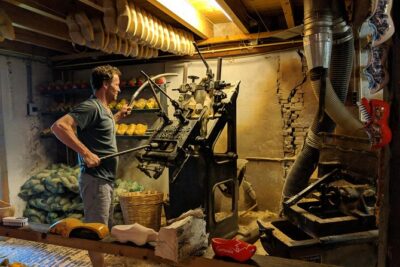
Countryside Bike Tour from Amsterdam: Cheese, Clogs & a Windmill
Read our review →
Electric Cycling Tour of Ubud with Free Hotel Transfer and Lunch
Read our review →
Browse the lists this tour appears in