
Review · CYCLING TOURS
Bhutan Mountain Biking tour
Bhutan Rides takes you far beyond the usual sightseeing route. Over about 10 days, you pedal from Paro through Thimphu, Punakha, Wangdue, and Phobjikha, mixing rough singletrack with mountain roads, pine forests, Buddhist temples, and long Himalayan views. The best part is the access: your bike gets you into quiet corners most visitors never reach.
I especially like the local trail focus and the way the riding is tied to Bhutanese culture. The Wangditse and KC trails give you real mountain biking, while Punakha Dzong, Gangtey Monastery, farmhouses, and village roads keep the trip from becoming one long workout. The guides, including Pelden, SP, ST, and Binesh, also have a reputation for helping with bike problems, not just leading the way.
The main caution is difficulty. This is not a gentle cycling holiday, even though the tour is described as suitable for people with moderate fitness. You will ride at altitude, climb to Dochula Pass at 3,140 meters, cover up to 86 kilometers in a day, and tackle technical trails. Your own mountain bike is not included, so budget for a rental or bring a properly prepared bike.
Key points before you book
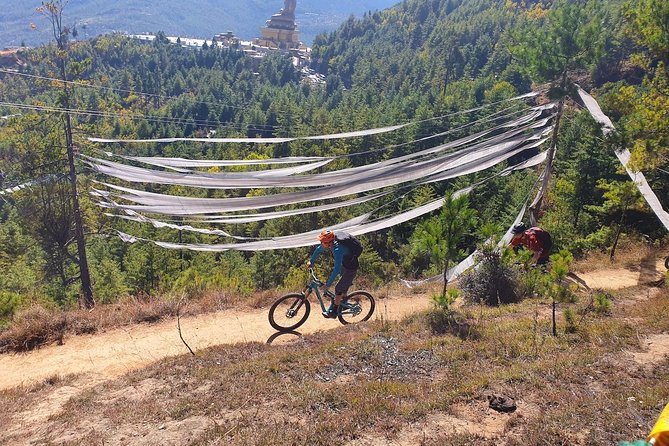
- The riding is genuinely varied: Expect road climbs, jeep tracks, forest singletrack, technical descents, and optional easier alternatives.
- Bhutan’s culture is part of every day: Dzongs, temples, monasteries, village roads, and a farmhouse hot-stone bath sit alongside the riding.
- Altitude shapes the trip: The route includes Thimphu, Dochula Pass, Gangtey, and other high areas, so the early easy riding matters.
- A support vehicle follows the route: Transfers, sightseeing, bike logistics, and meals are included, making a demanding trip easier to manage.
- The $4,200 price covers a lot: SDF, visa fees, permits, hotels, food, guides, transport, and sightseeing are included, but airfare, insurance, and the bike are extra.
- The tour is private: Only your own group participates, and the route can be adjusted to suit different riding levels.
Why this Bhutan bike trip feels different
Bhutan is not a place where mountain biking feels added on after the sightseeing. The roads, forest tracks, village paths, and steep hills are the way into the country. On this tour, the bike is your ticket to a closer look at Bhutan’s countryside.
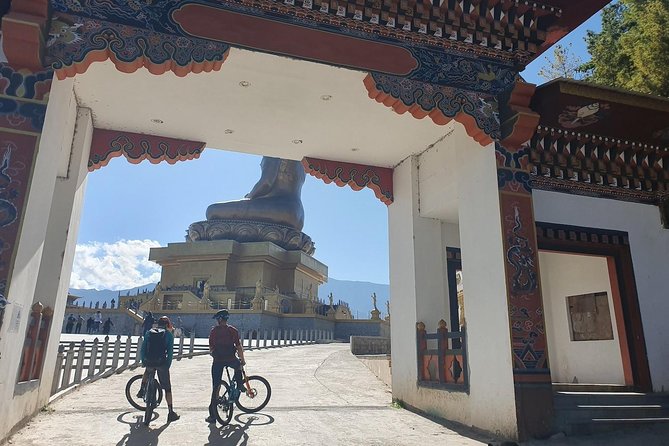
You will still see the major sights, including Buddha Point, Punakha Dzong, Gangtey Gonpa, Kyichu Lhakhang, Rinpung Dzong, and Tiger’s Nest. But the hours between those sights matter just as much. You may pedal through blue pine forest, stop beside an old iron bridge, pass rice fields, or eat a picnic lunch near a river.
The trip is designed around technical enduro-style riding, but Bhutan Rides can adapt the route to the ability of your group. That flexibility is important in Bhutan, where weather, trail conditions, altitude, and energy levels can change the shape of a day.
More mountain bike tours in the world:
- Waimea Canyon Downhill Bike Ride
★ 5.0 · 650 reviews - Ubud: Downhill Cycling with Volcano, Rice Terraces and Meal
★ 5.0 · 536 reviews - La Paz: Mountain Bike Down the World’s Most Dangerous Road
★ 4.9 · 386 reviews
Day 1: Paro arrival and a gentle first ride
Your Bhutan adventure begins before landing. The flight into Paro offers views of Himalayan peaks, including Mount Everest, Mount Kanchenjunga, Jomolhari, and Jichu Drakey. For the best view, ask for a seat on the left side of the aircraft at check-in.
At Paro International Airport, your guide meets you and transfers you to the hotel. Bikes supplied by the company can be assembled there, while riders bringing their own bikes can prepare and check equipment. This is a useful time to identify problems early. One rider arrived with a failed dropper post and received help from chief guide SP, who worked through the problem rather than leaving the rider without a key piece of equipment.
The first ride is an easy spin around the Thimphu Valley. That sounds modest, but it has an important job: getting your legs and lungs used to Bhutan’s altitude. Do not treat this first outing as a test. Save energy for the days ahead.
Day 2: A scenic road into Thimphu
The route to Thimphu covers about 60 kilometers on a scenic road. It is described as easy pedaling, which makes it a good second day for adjusting to the elevation and the rhythm of riding in Bhutan.
A stop at Tamchog Lhakhang breaks up the ride. You can cross the reconstructed iron bridge associated with the 15th-century Tibetan bridge builder Thangtong Gyalpo. It is a short cultural stop, but it gives you a feel for how Bhutan mixes working roads, religious sites, and old engineering in one small area.
If time and energy allow, you may ride the Wangditse loop, a favorite cross-country route near Thimphu. In the evening, the Memorial Chorten offers a quieter change of pace. The shrine was built in memory of Bhutan’s third king and remains an active religious site, not just a photo stop.
The practical point here is pacing. You have a full day, but the first two days are not meant to empty your tank. The harder trail work comes next.
Day 3: KC Trail, Buddha Point, and Wangditse
Day 3 brings the most concentrated riding around Thimphu. A gentle 4-kilometer climb takes you to Buddha Point, where the 169-foot Buddha statue looks over the capital.
From there, you ride the KC Trail, a 7-kilometer route that exits near Motithang. The riding then shifts back toward culture and nature with a visit to the Takin Reserve, where you can see Bhutan’s national animal.
The Wangditse singletrack begins near the radio tower. The loop covers about 6 kilometers, climbs roughly 300 meters through blue pine forest, and descends toward Wangditse Temple and Bebeba village. This is the sort of section that explains why a local riding company matters. The route is not simply a marked tourist road. Your guides can help you choose lines, judge conditions, and adjust the pace.
Expect a mixed day rather than nonstop downhill riding. You will climb, stop, ride narrow trails, and move between forest and settlement. If you prefer technical enduro riding, this is one of the days you will look forward to. If your mountain biking is limited to smooth paths, you may find the trail sections demanding.
A few more rides around the world worth a look
- Ninh Binh Day Trip: Hoa Lu-Trang An/Tam Coc-Mua Cave-Cycling-Boat
★ 5.0 · 1,886 reviews - Cai Be Mekong Delta Tour: Cooking Class, Cycling & Craft Villages
★ 5.0 · 1,881 reviews - The Grand Bicycle Tour by Cycle City Tours
★ 5.0 · 1,827 reviews - Countryside Bike Tour from Amsterdam: Cheese, Clogs & a Windmill
★ 5.0 · 1,485 reviews
Day 4: Dochula Pass and the descent to Lobesa
The climb from Thimphu toward Dochula Pass rises gradually for about 16 kilometers from Simtokha. At 3,140 meters, the pass is a serious altitude point, even though the road itself is steady rather than brutally steep.
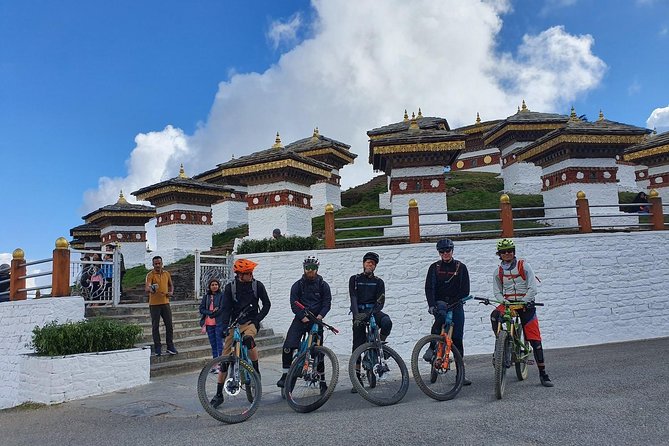
At the top, the Druk Wangyal Chortens form a group of 108 stupas built to honor the Fourth King. On a clear day, the Himalayan views are the reward for the climb. Weather can change quickly at this height, so carry layers and keep your expectations flexible.
There are two riding choices after the pass. If you want a more technical experience, the Madman Trail offers a singletrack descent. If you prefer an easier day, you can stay on the motor road.
The road descent to the lower rice valley of Lobesa covers about 40 kilometers. In Lobesa, the route includes temples connected with Drukpa Kunley, one of Bhutan’s most unusual historical religious figures. This combination is typical of the tour: a hard physical section followed by an encounter with a place that gives the day meaning.
Day 5: Punakha Dzong and the Sewla ridge
Punakha Dzong sits where two rivers meet. It served as Bhutan’s capital until 1955 and remains the winter home of the monk body. Its setting and scale make it one of the country’s essential sights, and visiting it by bike feels more satisfying than simply arriving by car.
The riding continues with the 7-kilometer Phophu loop, followed by about 10 kilometers of climbing on jeep track to Sewla. Then comes the day’s prize: a 10-kilometer ridge ride through pine forest.
This section is described as one of the finest cross-country singletrack routes in Bhutan. It is not free riding, though. You will need steady handling and enough energy for a long day that combines road, trail, and climbing. The listed riding time is six to seven hours, with roughly 45 to 50 kilometers covered.
An evening at the resort gives you a proper chance to recover. That matters because the next day is the longest distance of the tour.
Day 6: The 86-kilometer ride to Phobjikha Valley
The route to Gangtey and Phobjikha covers about 86 kilometers. Much of the day uses paved mountain roads, with a gradual climb toward Nobding and a lunch stop along the way.
After crossing the pass into Phobjikha Valley, you descend toward Gangtey Gonpa. From the monastery, the route shifts to a cross-country trail section. This gives the day a clear pattern: long road miles, mountain scenery, a high pass, then trail riding near the valley.
Do not underestimate the distance simply because much of the surface is paved. Eighty-six kilometers at altitude can be tiring, particularly after several previous riding days. The support vehicle and flexible transport are valuable here. If your group needs to shorten a section, you are not locked into pedaling every meter.
Day 7: Gangtey, Longtey, and a valley loop
Day 7 is more flexible. You begin at Gangtey Gonpa, an important monastery and monastic school. The ride then drops toward Longtey village and crosses pine forest trails on the southern side of the valley.
The route offers wide mountain views and a picnic lunch beside the river. You then continue through villages and make a loop around Phobjikha Valley. The total riding distance is about 50 kilometers.
There is also an option to take a rest day with short hikes instead of riding the full loop. I like this choice because the tour is physically dense. A break here could make the final days more enjoyable, especially if you are traveling with mixed abilities.
Phobjikha is also a good place to slow down. The riding is scenic, but the valley’s quiet roads and monastery provide a change from the sharper technical focus around Thimphu and Punakha.
Day 8: Returning to Paro with culture and a hot-stone bath
After breakfast, you drive back to Paro. The afternoon is set aside for sightseeing rather than a major ride, which gives your body a needed pause.
The cultural stops include Kyichu Lhakhang, a seventh-century monastery, Rinpung Dzong, and Dungtse Lhakhang. These visits help fill in the story of Bhutan’s religious architecture after several days of seeing temples and monasteries along the cycling route.
In the evening, you visit a farmhouse for an herbal hot-stone bath and a Bhutanese meal. This is one of the more personal parts of the schedule. It brings you into a local home setting rather than another hotel dining room.
You should not expect a luxury spa treatment. The value is in the setting, the tradition, and the chance to recover in a distinctly Bhutanese way.
Day 9: Riding to Tiger’s Nest
The final major day is built around Paro Taktsang, better known as Tiger’s Nest. You ride about 10 kilometers to the base, leave the bikes, and hike for around two hours to the monastery, which clings to a cliff about 1,000 feet above the valley.
This is a hike, not a casual sightseeing stroll. The tour offers the unusual option of pushing or carrying your bike upward and riding down afterward, but that choice should be reserved for strong riders who are comfortable with the terrain and the physical effort.
After returning to the valley, you ride to Drugyal Dzong and then back to the hotel for a farewell dinner. The day lasts about five hours, but the hike makes it feel longer than the clock suggests.
Tiger’s Nest is the right final stop. It gives the trip a clear cultural climax, while the ride to and from the base keeps the day connected to the central theme of the tour.
What the $4,200 price really covers
At $4,200 per person, this is an expensive holiday. But the figure includes more than guiding and hotel rooms. The price covers Bhutan’s $100-per-day Sustainable Development Fee, visa fees of $40 per person, required permits, transfers, sightseeing entrance fees, all meals, evening tea, mineral water, and 3-star accommodation.
It also includes a mountain biking guide, a cultural guide, an air-conditioned vehicle, nine dinners, ten breakfasts, and nine lunches. Those inclusions reduce the number of costs you need to manage once you arrive.
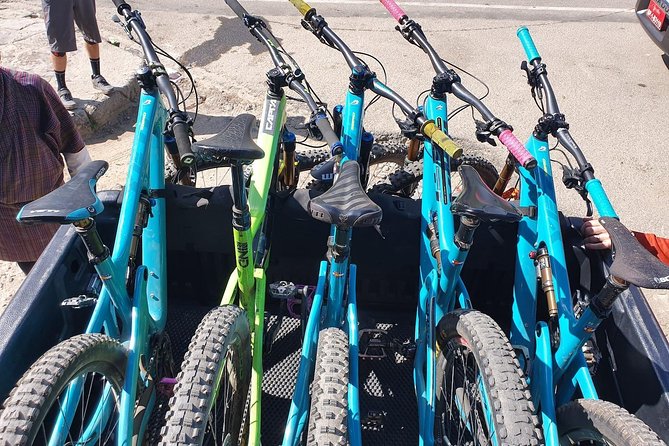
Airfare to Bhutan is not included. Neither is your mountain bike, though a bike can be rented separately. You also pay for personal expenses, laundry, phone use, tips, shopping, spa services, and travel and medical insurance.
The value is strongest if you want a fully arranged private trip with serious riding and cultural stops. It is weaker if you only want a few casual bike outings, since you would be paying for a 10-day route built around demanding mileage and support.
Who should book this tour?
You should consider it if you already ride mountain bikes regularly and enjoy technical trails, long descents, climbing, and changing surfaces. The strongest match is someone who wants both enduro-style riding and a close look at Bhutanese religious sites, villages, food, and mountain roads.
The tour can be adapted, but you should not assume that customization turns it into an easy holiday. The standard route includes high passes, long days, and technical trail options. A private group makes it easier to adjust the pace, take a rest day, or use the support vehicle for a section.
Bring a reliable mountain bike if possible, especially one suited to technical riding. Check your brakes, tires, suspension, and dropper post before departure. The team has helped with mechanical problems, but arriving with a well-prepared bike gives you more time to ride and less time to troubleshoot.
Pickup begins at Paro International Airport at 8:15 a.m. Confirmation is provided at booking, and the activity is private for your group. A moderate level of physical fitness is required, though the distances and altitude make solid cycling fitness a sensible target.
The cancellation rules are worth noting. Cancel at least six full days before the start for a full refund. A cancellation made two to six days ahead receives a 50 percent refund, while cancellation less than two days before the start is nonrefundable. Poor weather or failure to meet the minimum number of participants can lead to a different date or a full refund.
Should you book Bhutan Rides?
Book this tour if your idea of Bhutan includes pine-forest singletrack, steep climbs, Buddhist temples, long road descents, and a support vehicle carrying the practical load. The mix of riding and culture is the strongest reason to choose it.
Think twice if you want relaxed cycling, low altitude, or a short sightseeing holiday with a few bike rides added. The route is ambitious, and the $4,200 cost rises once you add airfare, insurance, and a bike rental.
For a committed mountain biker, Bhutan Rides offers something hard to arrange independently: local trails, experienced guides, cultural access, meals, transport, and a route that reaches well beyond Paro’s main sights. The best booking decision is to be honest about your fitness, then ask for a version of the schedule that matches your group before you pay.
FAQ
Where does the Bhutan mountain biking tour begin?
The tour begins at Paro International Airport in Bhutan. The stated meeting time is 8:15 a.m.
How long does the tour last?
The tour lasts approximately 10 days, from arrival in Paro through airport transfer on the final morning.
Is the tour private?
Yes. Only your own group participates in the activity.
Is a mountain bike included?
No. You need to bring your own mountain bike or arrange a rental separately through Bhutan Rides.
What level of fitness do I need?
The tour requires a moderate level of physical fitness, but the route includes long rides, high-altitude roads, technical trails, and a maximum stated distance of 86 kilometers in one day.
Are meals included?
Yes. The package includes breakfast on all 10 days, nine lunches, nine dinners, evening tea, and drinking mineral water.
Is accommodation included?
Yes. The price includes accommodation in 3-star hotels.
Is airfare to Bhutan included?
No. Airfare to Bhutan is not included in the tour price.
What happens if bad weather cancels the tour?
If poor weather causes a cancellation, you will be offered a different date or a full refund.
Just added around the world
- Yogyakarta: Countryside Cycling and Cooking Class Experience★ 4.9 · 8 reviews
- Zagreb: 2.5-Hour Cycle Back to Socialism Tour★ 4.6 · 25 reviews
- Zell: Bike and boat tour with wine tasting and picnic★ 4.7 · 3 reviews
- Yogyakarta: Countryside Village Cycling Tour With Guide★ 5.0 · 16 reviews
- Amsterdam: Zaanse Schans E-Bike Tour with Windmills & Cheese★ 4.5 · 12 reviews
- World’s Most Dangerous Road “Private” Mountain Biking Trip★ 5.0 · 7 reviews
- Yangshuo: Highlights Karst landscapes & Village Cycling★ 5.0 · 4 reviews
- Yamaha Fat Bike Adventure: Valencia’s Past and Future★ 4.5 · 2 reviews
Mountain Bike Tours, compared.
Downhill Cycling with Volcano, Rice Terraces and Meal
Read our review →
Mountain Bike Down the World’s Most Dangerous Road
Read our review →
Chiang mai Hike & Downhill Bike Adventure –Suthep National Park
Read our review →Downhill Cycling with Volcano, Rice Terraces, and Meal
Read our review →
Browse the lists this tour appears in