
Review · AMSTERDAM
Amsterdam in World War Two Cycle Tour
Amsterdam’s WWII story comes into sharper focus when you ride through the neighborhoods where it happened. This small-group tour moves beyond the Anne Frank House and central canals to Amsterdam South, where apartment blocks, school buildings, squares, and quiet corners still mark raids, resistance work, collaboration, and liberation.
I like the maximum of six riders, which keeps the experience personal, and I like the use of wartime photographs at the exact places you visit. Rudy, a lifelong local and history professor, brings family connections to the area, while Peter also guides some departures. The main consideration is practical: the tour appears to require your own bike, so confirm that point before booking.
- Ride through Amsterdam South, covering more ground than you could on foot.
- Compare wartime photographs with present-day streets at many stops.
- Visit Anne Frank’s former neighborhood at Merwedeplein and the bookshop where Otto Frank bought her diary.
- See former Nazi offices, resistance sites, and raid locations away from central Amsterdam.
- Travel in a group of no more than six, with time for questions and discussion.
- Stop briefly at Café Wildschut for coffee and a restroom break.
Why Amsterdam South Tells a Different WWII Story
Most first-time visitors meet wartime Amsterdam through Anne Frank’s house, the Resistance Museum, or a walking route in the canal belt. This bike tour takes you somewhere quieter and more local. You ride through Amsterdam South, where the evidence is often an ordinary street corner, a school, a former office, or a small memorial.
That setting matters. The tour does not present WWII as one large story viewed from a museum display. It connects specific addresses to raids, deportation, collaboration, resistance, military occupation, and the unsettled days after liberation.
The cycling format also helps. Amsterdam South is spread across a substantial area, and riding lets you connect places that would feel scattered on foot. You can see how Jewish homes, Nazi offices, resistance addresses, military headquarters, and public squares fit together within the same city.
The route lasts roughly two and a half to just over three hours. That is long enough for a serious history lesson, but not so long that the subject becomes exhausting for most adults who are comfortable cycling.
A Small Group With a Strong Local Connection
The group limit of six is one of the best features here. You are not trying to hear a guide over a large pack of cyclists, and it is easier to stop for questions without holding up a crowd.
Rudy is the guide most closely associated with this experience. He grew up in the neighborhoods on the route and teaches history. That combination gives the tour two useful layers: the broad facts of the occupation and the personal sense of someone who knows the streets as home.
Rudy also shares family experiences connected with the war and the postwar years. That does not replace documented history, but it gives the places a human scale. A street is no longer just the location of an office or raid. It becomes part of a neighborhood where families lived, worked, hid, resisted, and tried to carry on.
Peter also leads some tours. The supplied details describe both men as able to answer questions and discuss Amsterdam beyond the specific route. If having a particular guide matters to you, ask at booking, since the guide may vary.
One important point: the tour information does not clearly state that bicycles are supplied. The descriptions repeatedly point riders toward bringing a bike, so you should confirm your arrangements before paying. The listing gives Tesselschadestraat 1 as the meeting point at 11 a.m., while the route description begins at Victorieplein and ends after a ride through Vondelpark toward Leidseplein. Ask the operator how the group gets from the meeting point to the first historical stop and where the bikes should be ready.
More heritage and temple rides in Amsterdam:
- Half-Day Ubud Electric Cycling Tour to Tirta Empul Water Temple
★ 5.0 · 315 reviews - Sukhothai: Historical Park & Countryside Cycling Tour
★ 5.0 · 276 reviews - Full Day Cycling tour to Sukhothai Historical Park
★ 5.0 · 163 reviews
Victorieplein and the June 1943 Raid
The route begins its historical work at Victorieplein, formerly Daniël Willinkplein. On June 20, 1943, the square and nearby areas were involved in a major roundup of Jewish residents.
At the foot of the Skyscraper, large groups of Jewish people were arrested in what the Nazi authorities called a Judenaktion. Dutch police units and police volunteers linked to the Dutch National Socialist Movement helped carry out the arrests.
The people taken here were brought to Olympiaplein, among other places, for registration. From there, many were sent east to Westerbork, the transit camp used before deportation to concentration and extermination camps.
This opening stop gives you an early sense of the tour’s approach. It focuses not only on German orders but also on Dutch participation. That is an uncomfortable part of the story, and it is important. Occupation was enforced through German institutions, but Dutch police and collaborators also played roles.
Merwedeplein and Anne Frank’s Family Home
At Merwedeplein 37-II, the Frank family lived before going into hiding. In the summer of 1942, Otto Frank took his family and several acquaintances to the Secret Annex on Prinsengracht, where his company was based.
A statue of Anne Frank now marks the square. The location helps place her story in a real residential neighborhood before the diary, the hiding place, and the worldwide fame. You are looking at the kind of everyday street where families lived ordinary lives until occupation policy destroyed that normal life.
Around the corner, the Jimmink bookshop on Waalstraat remains in operation. During the war’s aftermath, Otto Frank bought Anne’s diary there. The first edition of The Secret Annex was published by Contact in 1947.
This is one of the tour’s most affecting stops because it connects three moments: the Frank family’s prewar home, the hidden life on Prinsengracht, and the publication of the diary after the war. It also keeps the focus on Amsterdam itself, rather than treating Anne Frank’s story as separate from the city around her.
The Tilex Bar and a Musician’s Survival
At Waalstraat 48, now Café Blek, the former Tilex Bar was run by Tilly and Lex van Weren. Lex survived Auschwitz because he was required to play his trumpet at executions.
The detail is brief, but its impact is severe. It shows how survival in the camps could depend on a terrible and arbitrary assignment. A bar on a neighborhood street becomes a way to discuss the choices forced on prisoners and the lives they tried to rebuild afterward.
The tour does not turn every stop into a long lecture. Instead, it uses individual stories to make the larger machinery of persecution easier to grasp.
A few more rides around Amsterdam worth a look
- Countryside Bike Tour from Amsterdam: Cheese, Clogs & a Windmill
★ 5.0 · 1,485 reviews - Amsterdam: Cheese Tasting, Windmill & Countryside Bike Tour
★ 4.7 · 386 reviews - Amsterdam Countryside Bike and Kayak Tour
★ 5.0 · 215 reviews - From Amsterdam: Countryside Bike Tour
★ 4.9 · 200 reviews
Police Barracks at Cornelis Troostplein
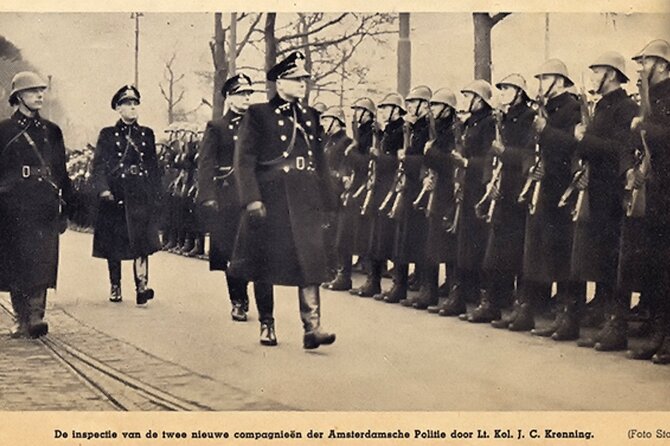
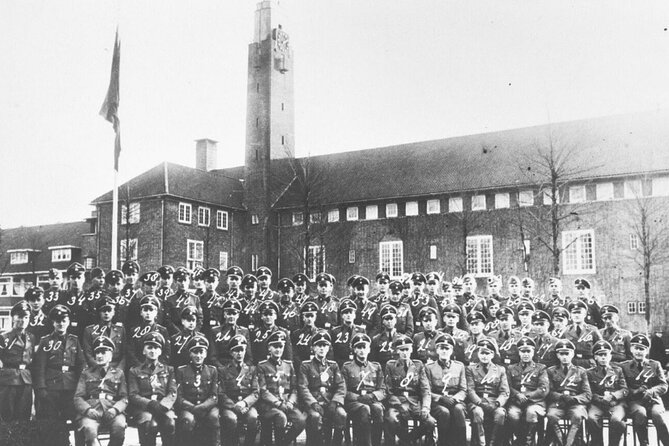
Cornelis Troostplein 23 once housed the PBA barracks, the Amsterdam police battalion involved in occupation-era enforcement. Before the war, the site had been a Catholic complex with two convents and a school, known as Peace Parish.
In spring 1942, the head of the Sicherheitsdienst and Gestapo in the Netherlands, Rauter, inspected the PBA. He later met Heinrich Himmler at Museumplein.
This stop is useful because it shows how familiar civic and religious spaces were repurposed during the occupation. The address was not an isolated military compound. It was part of an existing neighborhood, and its function changed under German control.
Museumplein as a Nazi Stronghold
Museumplein looks spacious and cultural today, but during the war the Germans turned it into a fortified center of occupation power.
Facing the Concertgebouw, buildings on the left held German offices. The former United States consulate housed the Zentralstelle für Jüdische Auswanderung, the office responsible for forced Jewish emigration policy. Nearby were the Ortskommandantur, or town command headquarters, and the Feldgendarmerie, the military police.
Other buildings held Nazi Party offices and related services. On the square in front, the Germans built bunkers and anti-aircraft batteries on the grounds of the Amsterdam skating club. The Amsterdam headquarters of the NSB, the Dutch Nazi movement, was next to the concert hall.
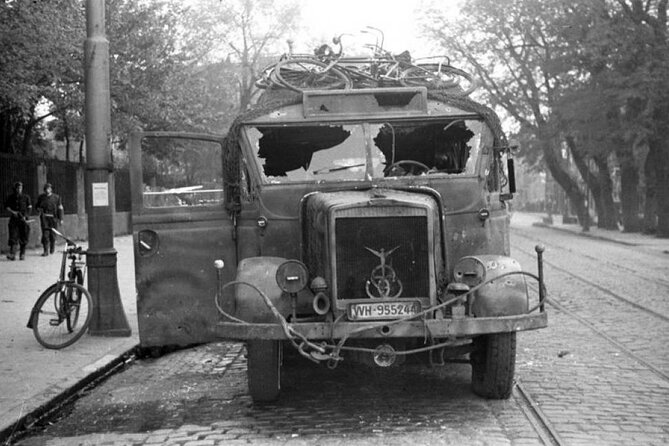
The bunkers were destroyed after the war, so old photographs are especially valuable here. They let you picture the barriers, military hardware, and offices that once occupied this familiar public space.
This is also a good example of why cycling works. You can take in the wide area and then move quickly to the next address without spending much of the tour walking between distant sites.
Coffee, Resistance Photography, and a Local Memorial
At Roelof Hartplein, the group stops at Café Wildschut for about ten minutes. You can get coffee and use the restroom. It is a modest break, but welcome during a three-hour ride and a subject as heavy as this.
Nearby, a former photo shop next to the library served the Dutch resistance. Resistance workers developed photographs there, including images by Charles Breijer of the first roundup of Jewish people in Amsterdam by the SD, Gestapo, and German order police.
You also see a small monument remembering Jewish people taken from the neighborhood. The pairing of the photo shop and monument is effective. One marks the effort to document what was happening, while the other honors people who were seized.
Apollolaan, Euterpestraat, and Resistance Retaliation
At the corner of Beethovenstraat and Apollolaan, the guide discusses the killing of Herbert Oelschlägel, an SS officer and SD or Gestapo agent. A Dutch resistance member executed him near number 6 in late October 1944.
The German response was brutal. Two houses were burned, and 29 resistance fighters were executed.
The street numbers remain much as they were during the war, which helps you connect the event to a precise location rather than a vague part of town. This stop also makes clear that resistance brought danger not only to the people carrying out attacks but to nearby residents and captured fighters.
The former Euterpestraat is linked to Gerrit van der Veen, leader of an important Dutch resistance group. You then reach the corner of Memlingstraat and Rubensstraat, where two major Nazi oppression offices once operated.
One was the Amsterdam SD headquarters under Willy Lages. The other was the Hausraterfassungsstelle, which recorded and stole the possessions of deported Jewish people. Its Dutch leader, Henneicke, was a collaborator.
In November 1944, the resistance asked the Royal Air Force to attack these offices. Destroying files was a major aim. Group Captain Denys Gillam, leader of 149 Typhoon Wing, carried out the attack.
At the nearby corner of Rubensstraat and Gerrit van der Veenstraat, a resistance safehouse was betrayed to the SD by a female informant in June 1944. A Stolperstein, or stumbling stone, marks the address.
This part of the route is particularly strong for anyone interested in the Dutch resistance. You see how resistance groups gathered information, used safehouses, sought allied air support, and faced betrayal.
Olympiaplein and the Machinery of Deportation
At Olympiaplein and Parnassusweg, the guide returns to the June 1943 raid. Jewish people arrested at the sports complex were registered here by the SD and Gestapo with help from Jewish camp police sent from Westerbork.
The detail is painful because it shows how Nazi authorities forced some prisoners into administrative roles within the system. Registration sounds harmless on paper, but here it formed part of the process that moved people toward deportation.
The monument at Parnassusweg gives the stop a physical point of focus. You are not simply hearing dates and names. You are standing where people were processed after being taken from their homes.
Luftwaffe Headquarters and an Act of Defiance
At Valeriusplein, the Amsterdam Lyceum served as Luftwaffe headquarters near the end of the occupation. The building’s school function makes the wartime use especially striking.
At Emmalaan and Prins Hendriklaan, you see the statue of Queen Emma. In summer 1940, people placed flowers there in defiance of the German occupiers.
Charles Breijer photographed a guard at the Kriegsmarine headquarters in 1944. The image is part of the tour’s larger method: use a photograph from the occupation to connect a modern street with the people and power once visible there.
Small acts such as laying flowers can seem minor beside raids and executions. Yet public defiance carried risk, and these gestures gave people a way to express opposition when open protest was dangerous.
Liberation, Violence, and the Route Back
The final historical point concerns May 7, 1945, when the Germans surrendered. Surrender did not make every street safe at once. Armed German troops and resistance fighters faced one another, and shootings took place amid the confusion and anger of liberation.
A monument marks victims of one of those shootings on the last day. It is a sober ending, and an honest one. The story does not stop neatly at the moment the occupation ends.
From there, the guide takes you through Vondelpark toward Leidseplein, where the route finishes. The listed end point returns to the meeting area, but the route details also refer to Leidseplein as the place where the group started. Because the meeting-point information is not perfectly consistent, confirm the exact start and finish arrangement before you go.
What the $66.09 Price Buys You
At $66.09 per person, this is not the cheapest way to see Amsterdam. You are also paying for a short tour, lasting about two hours and 30 minutes to three hours and 10 minutes, rather than a full-day outing.
The value comes from the combination of local access, transport, and interpretation. A walking tour could cover some of these addresses, but not as efficiently. A large bus would make many of these neighborhood stops difficult or impossible, and a standard city sightseeing ride would not provide this level of WWII detail.
The small group is important to the price. You get more room for questions, and the guide can use printed photographs and a map without fighting for your attention. If you already have a bike and care about Amsterdam’s wartime past, the cost is fair.
If you do not cycle comfortably, dislike serious historical material, or want only central Amsterdam highlights, this may not be your best buy. The tour is built around riding and sustained attention, not quick photo stops.
Who Should Book This Bike Tour?
I would choose this experience if you want to understand Amsterdam beyond its canals and famous museums. It suits adults, older children who can manage the ride, history students, and anyone interested in Anne Frank’s life as part of a larger city story.
It is especially useful after visiting the Anne Frank House or the Resistance Museum, though neither is required. The route adds places that are easy to miss and shows how occupation affected several neighborhoods at once.
You should be comfortable cycling for up to three hours and prepared for serious subject matter. The tour is described as safe and well structured, but no detailed cycling requirements or bike equipment information is provided. Ask about the bike before booking.
Free cancellation is available if you cancel at least 24 hours before the 11 a.m. start time. Changes or cancellations made inside that period are not accepted for a refund.
Should You Book It?
Book this tour if you want a personal, place-based account of Amsterdam during WWII, especially if you already know Anne Frank’s basic story and want to see the surrounding neighborhoods. The small group, exact-location photographs, and Rudy’s connection to Amsterdam South give it more depth than a standard sightseeing ride.
Skip it if you need a supplied bicycle, prefer a lighthearted city tour, or want to remain in central Amsterdam. If you do book, confirm the bike arrangement, exact meeting route, and guide assignment. For the right rider, this is a thoughtful way to see how war, resistance, collaboration, and memory remain visible on ordinary Amsterdam streets.
FAQ
Where does the Amsterdam WWII Cycle Tour start?
The listed meeting point is Tesselschadestraat 1, 1054 ET Amsterdam, with an 11 a.m. start. The historical route itself begins at Victorieplein, so confirm the exact meeting arrangement with the operator.
Where does the tour finish?
The activity information says it ends back at the meeting point. The route description says the guide takes the group through Vondelpark toward Leidseplein, so you should confirm the precise finishing location before the tour.
How long does the tour last?
The tour lasts approximately two hours and 30 minutes to three hours and 10 minutes.
How many people can join?
The maximum group size is six riders.
Is the tour offered in English?
Yes. The experience is offered in English.
Do I need to bring a bicycle?
The supplied information does not confirm that bicycles are provided. The tour description advises riders to bring a bike, so confirm the bicycle arrangement with Slagveldreizen.nl before booking.
What historical places are included?
Stops include Victorieplein, Merwedeplein, Waalstraat, Cornelis Troostplein, Museumplein, Roelof Hartplein, Beethovenstraat, former Euterpestraat, Memlingstraat and Rubensstraat, Olympiaplein, Valeriusplein, and the Queen Emma statue at Emmalaan and Prins Hendriklaan.
Can I cancel for a full refund?
Yes, if you cancel at least 24 hours before the experience start time. Cancellations or changes made less than 24 hours in advance are not accepted for a refund.
Just added around Amsterdam
- Amsterdam: Zaanse Schans E-Bike Tour with Windmills & Cheese★ 4.5 · 12 reviews
- Bikes, Beers and Bites: City Food, Drink, & Cycle Tour★ 5.0 · 2 reviews
- Zaanse Schans Windmills E Bike Day Trip from Amsterdam★ 5.0 · 15 reviews
- Amsterdam Countryside Bike Tour★ 4.0 · 19 reviews
- Amsterdam: 3-hour Countryside Bike Tour★ 4.3 · 2 reviews
- Amsterdam: Leisurely Windmill & Countryside Bike Ride★ 5.0 · 24 reviews
- Amsterdam: Countryside Bike Tour★ 4.9 · 9 reviews
- Amsterdam: Countryside Bike and Kayak Guided Tour★ 4.7 · 45 reviews
Heritage & Temple Bike Tours, compared.

Half-Day Ubud Electric Cycling Tour to Tirta Empul Water Temple
Read our review →
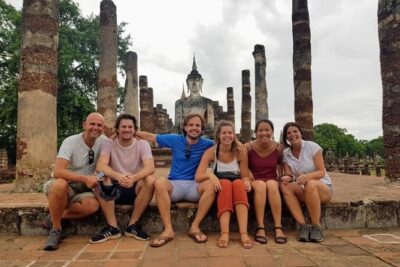
Full Day Cycling tour to Sukhothai Historical Park
Read our review →

Discover Trang An Natural World Heritage, Bich Dong Pagoda, Cycling Day Tour
Read our review →
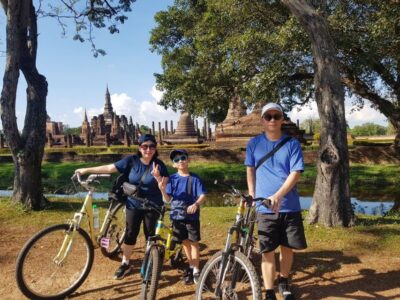
Full-Day Historical Park Cycling Tour with Lunch
Read our review →
Full Day Cycling Amazing Chiangrai countryside and the White temple
Read our review →Browse the lists this tour appears in